
Invited paper presented at the International Conference on Cultural Complexity and Computational Approaches, Málaga, Spain, 30 June–2 July 2026.
Kategorie: Vorträge
-
Conversation: „Art, Complexity and Uncertainty: a conversation with David Familian“.
Read the fascinating interview with curator and artist David Familian about art and complexity here!
Yearbook for Philosophy of Complex Systems, 1 (2025): 235 – 248 https://doi.org/10.3790/pcs.2025.1461904
-

A course on complexity as a part of: „Forests as complex systems field course“
Teaching theoretical concepts, such as resilience or complexity theory, provides unique challenges especially in applied disciplines. Current trends such as global change will require natural resource disciplines, such as forestry and agriculture, to expand their scientific basis and possibly shift their dominant paradigms to adopt a broader view of the systems they manage as complex social-ecological systems. This likely will result in borrowing and adapting theories and concepts from other disciplines, such as complexity science. Students in natural resources will need more training in these paradigms and learn to incorporate concepts such as thresholds, uncertainty, and cross-scale interactions as they affect ecosystem dynamics into management or restoration prescriptions. Numerous courses and approaches exist that teach general complexity concepts, including management implications at the governance levels. However, we do not know of any courses where these concepts are specifically applied to practical management challenges. This course aims to overcome this shortcoming by providing field exercises that can are used to link theoretical concepts from complexity science to applied forest management issues regardless of management objectives.
-

Vortrag: “Der Kreislauf: Das Pharmakon der Asymmetrien. Eine technikphilosophische Lesart des Verhältnisses von Zirkularität und Entropie”
Es ist ein Vergnügen, an der Veranstaltung „Aufbrüche der Medienphilosophie” teilzunehmen, insbesondere an dem Vortrag „Der Kreislauf: Das Pharmakon der Asymmetrien”. Eine technikphilosophische Lesart des Verhältnisses von Zirkularität und Entropie” teilnehmen zu dürfen!
Programm
-
Lecture: “Emergence through environmental embedding.”
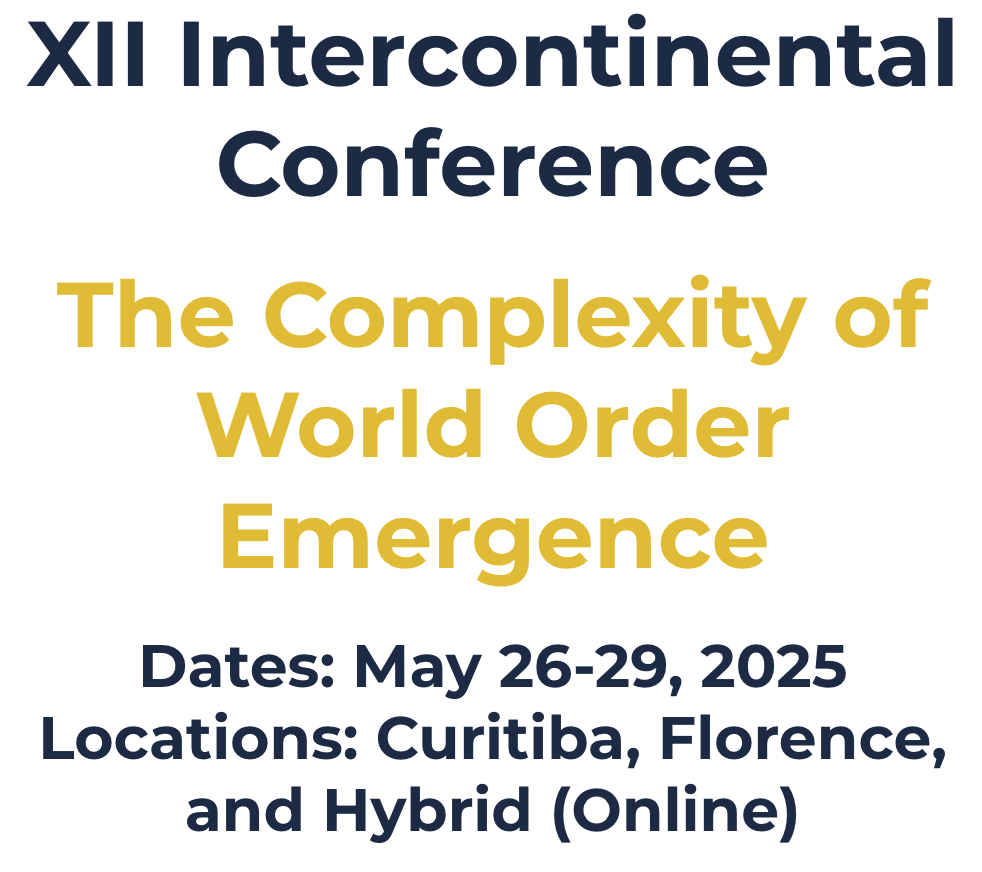
I am delighted to present my lecture, ‚Emergence through Environmental Embedding‘, at the XII Intercontinental Conference, ‚The Complexity of World Order Emergence‘, organised by the World Complexity Science Academy (WCSA).
Abstract
The aim of my presentation is to present the philosophical theories to understand the phenomenon of emergence, not as the matter itself, but as the (self-)organisation of the system. The organisation of the system arises from the relational correlation between system and environment, in such a way that the emergence can also be successful, under condition of embedding in the system. The ecological relational of embedding is the principle of generation of structures or emergence of patterns.
The ontological analysis of the concept of emergence shows that only the embedding of emergent properties in certain emergent levels or layers enables the permanent emergence of new structures. Conversely, the singular appearance of any new thing as an object, property, or structural element would only be an irrelevant variation of the given, which occurs constantly and everywhere anyway. The resulting ontological questions are, for example What is an emergent level? How do individual variations of the given gradually coalesce into emergent properties and objects? How can the relationship between different emergent levels be described?
The ontological approach to the study of emergence is thus holistic in nature, i.e. it sees the whole of a structural section of the world as the actual carrier of emergence. If we assume that emergence is a certain kind of event, i.e. a process, then emergence theory falls within the realm of general process philosophy. It follows that general process conditions, i.e. those that apply to any conceivable process, must also apply to emergent processes. Emergence as a structural phenomenon can thus be understood as a differentiation of antecedent process conditions.