-
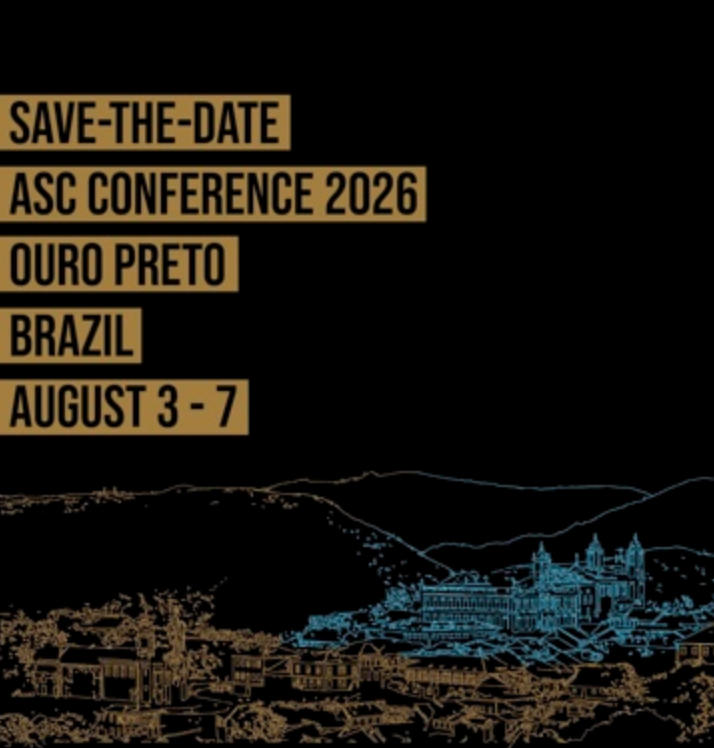
Epistemology After the Algorithm: A Second-Order Cybernetic Intervention
ASC Conference Track 7, Conversational Confluences (American Society for Cybernetics Conference – August 3–7, 2026)
Organized by Arantzazu Saratxaga
This proposal outlines a collaboration within the ASC framework to create a collective
working space leading to a joint publication. The project explores the emancipatory potential
of second-order cybernetics as a response to the epistemological foundations of contemporary
algorithmic governance.Algorithmic governance rests on the assumption that reality is objectively given, fully
modelable, and manageable through computation. This premise shifts epistemic authority to
algorithmic systems, treated as neutral producers of comprehensive knowledge. The
dominance of AI depends on the belief that algorithmic models generate objective truth.
Consequently, power is delegated to systems that claim neutrality while concealing their
selective operations. A “God’s eye” perspective emerges, legitimizing algorithmic authority
not only through performance but through an attributed status of objectivity and omniscience.
The track challenges this logic through second-order operative epistemology. Rather than
presuming objectivity, second-order cybernetics observes observation itself. It emphasizes
that every observation is selective and entails blind spots. Knowledge arises not from
representing reality but from reflecting on how observations are constructed. This perspective
questions the promises of transparency, automation, and total control.The track will address central epistemological tensions: observation versus representation;
self-organization versus algorithmic determinism; transparency versus the blind spot of
observation; communication versus control; reflexivity versus automation; and uncertainty
versus the illusion of total calculability.Drawing on cybernetic operative knowledge, the track aims to critically examine the
epistemological foundations of algorithmic power, expose their fragility, and open alternative
spaces for thought and action, laying the groundwork for a subsequent joint publication.Keywords: AI, Epistemologies, Second Order
-
The Gorgon’s Gaze: Recursion at the Abyss of Truth
Luhmann Conference 2026
14–18 September 2026
This presentation examines operative recursion in Niklas Luhmann’s systems theory as the epistemological limit of truth. It argues that recursion is not merely a logical or systemic principle but marks a fundamental horror vacui of truth. Once truth can no longer be conceived as correspondence between observation and reality, the disappearance of any external epistemic ground leaves a void that recursive communication incessantly seeks to fill. Every act of observation is referred back to the conditions of its own possibility, unfolding an endless movement of self-reference from which no privileged standpoint can emerge.
Truth thus assumes an irreducibly paradoxical form. The operative closure of self-referential systems renders the world observable only by simultaneously producing new forms of unobservability. Every distinction generates its own blind spot; every act of seeing presupposes what it cannot see. The epistemological force of recursion resides precisely in this impossibility of occupying an Archimedean point outside communication. Truth no longer rests upon ontological foundations but emerges as a contingent effect of recursive communicative operations.
The paper develops this argument through a communicological reading of the Gorgon. Rather than serving as a merely mythological figure, the Gorgon becomes an epistemological figure of radical unobservability. Her gaze marks the threshold at which observation encounters the opacity of its own conditions and collapses into reflexivity. The disclosure of recursion therefore culminates not in transparency but in a horror vacui of truth: the abyss opened by the absence of any external foundation is continuously occupied by further operations of observation. The Gorgon thus embodies not the terror of truth itself, but the unsettling impossibility of escaping its recursive production—a truth that never reaches completion but endlessly reproduces the conditions of its own emergence. -
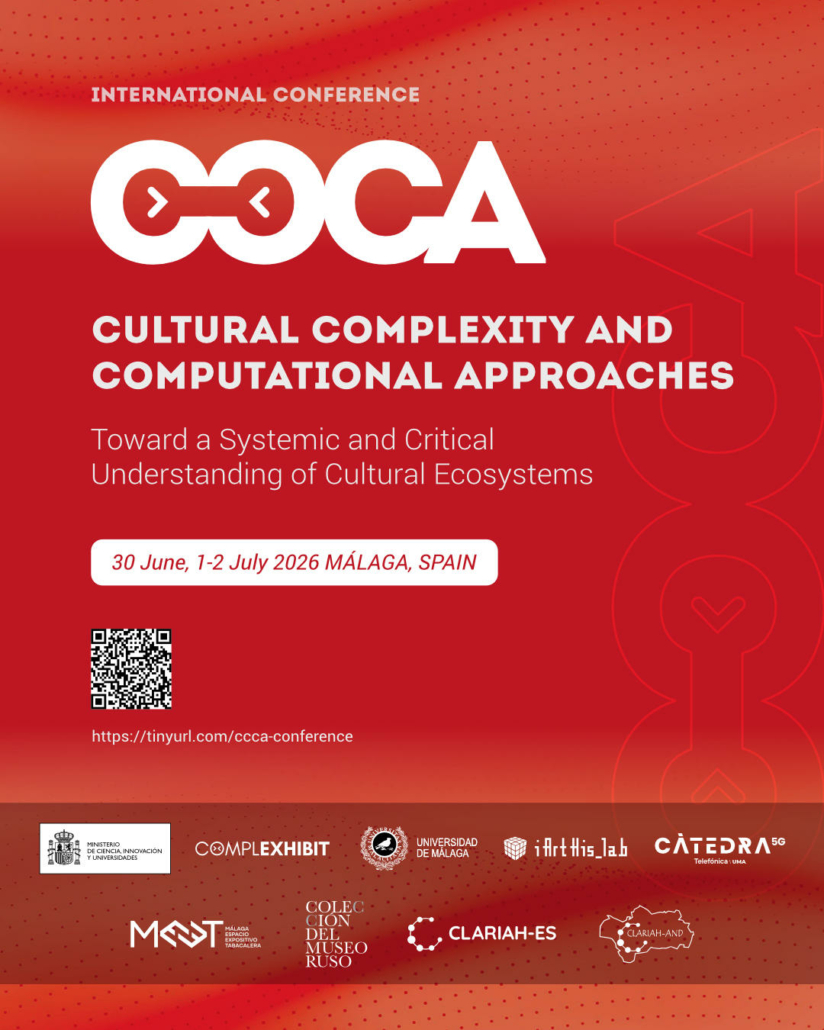
The Order of Indeterminacy: Complexity, Uncertainty, and the Black Box – The Limits of Modelling
Invited paper presented at the International Conference on Cultural Complexity and Computational Approaches, Málaga, Spain, 30 June–2 July 2026.
-
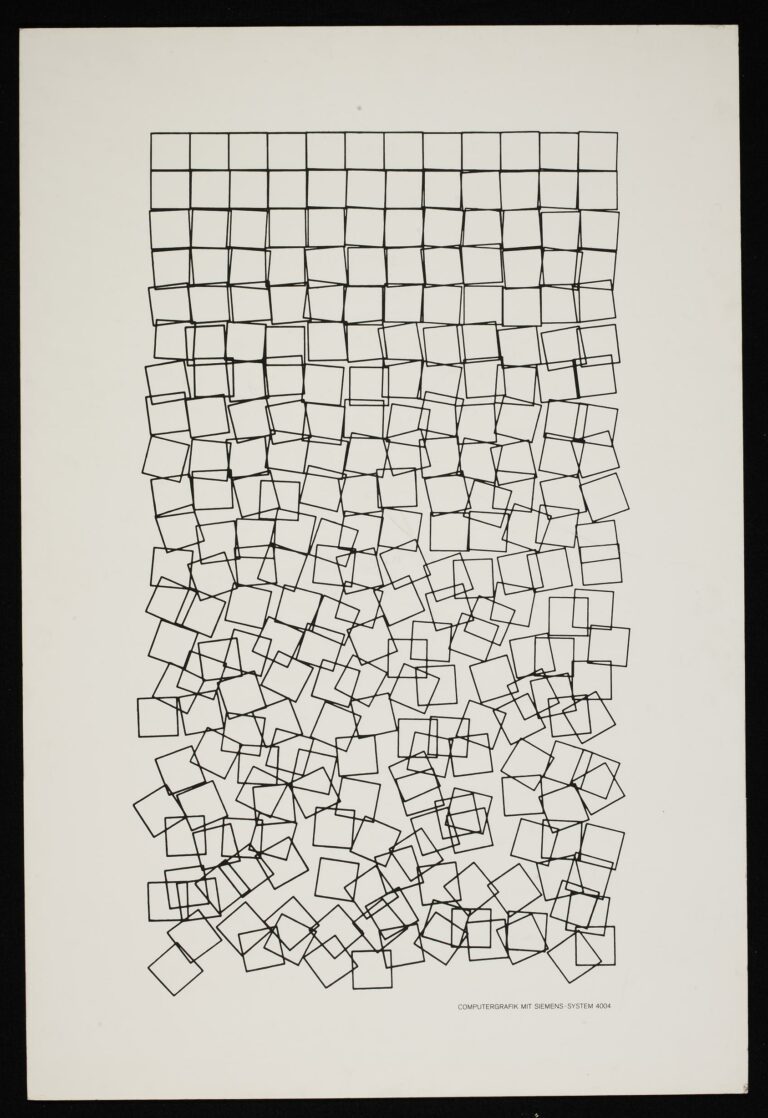
SoSe26 Seminar, abk Stuttgart: „Prozessualität der Form: Grundzüge einer generativen Formtheorie“
Das Seminar untersucht das „Generative“ als ästhetischen Leitbegriff mit besonderem Fokus auf die Form. Im Zentrum steht die Frage, wie Form im Kontext generativer Prozesse entsteht und wie sich dieses Entstehen beobachten, denken und zur Sprache bringen lässt. Generative Kunst verschiebt die Aufmerksamkeit vom abgeschlossenen Werk auf den Prozess der Hervorbringung von Bild- und Strukturformationen. Form erscheint dabei nicht als Abbild oder Repräsentation einer Idee (eidos), sondern als emergente Gestalt, die sich im Vollzug komplexer Prozesse konstituiert.
Ausgehend von einer kritischen Analyse hylemorphistischer und substanzontologischer Formkonzeptionen – Form als eidos oder als die Materie (hylé) in-formierende Idee – entwickelt das Seminar eine nicht-repräsentationale und relationale Theorie der Form. Form wird als situierte Stabilisierung komplexer Prozesse verstanden: als Muster, das aus Rückkopplung, Resonanz und Wechselwirkung hervorgeht. Sie ist keine statische Struktur, sondern eine zeitlich gebundene, dynamische und „merkende“ Konfiguration innerhalb komplexer Systeme. Form erscheint somit als emergentes Ereignis, das sich im Verlauf der Zeit transformiert. Reflektiert werden eine Ästhetik des Verschwindens, der Instabilität und der Transformation ebenso wie Gestaltung als Ermöglichung von Emergenz.
Theoretisch verbindet das Seminar philosophische Perspektiven (Differenzphilosophie, Systemtheorie, Phänomenologie, feministischer Materialismus) mit ästhetischen Theorien, insbesondere der generativen Ästhetik, sowie mit Bezügen zur ästhetischen Gestalttheorie (Rudolf Arnheim). Ergänzend werden kunst- und medienhistorische Positionen einbezogen: im Kontext generativer Gestaltung George Nees, Frieder Nake und Manfred Mohr, im Feld generativer Kunst Herbert W. Franke. Darüber hinaus werden Referenzen zum Konstruktivismus, zur Konkreten Kunst, zum Bauhaus, zur Lichtkunst (László Moholy-Nagy), zur Netzwerkkunst sowie zu Arbeiten von Victor Vasarely, Gerhard von Graevenitz, Herman de Vries und Myron Krueger hergestellt.
- Präsentation
15.05. (14:00 Uhr–18:00 Uhr) - Form und Eidos und ihre Dekonstruktion
22.05. (10:00 Uhr–18:00 Uhr)
23.05. (10:00 Uhr – 14:00 Uhr) - Prozesualität der Form – Gestalttheorie in der Kunst & Paradoxien der Form
11.06. (14:00 Uhr–18:00 Uhr)
12.06. (10:00 Uhr–18:00 Uhr) - Generative Kunst & Generative Ästhetik
25.06. (14:00 Uhr–18:00 Uhr)
26.06. (10:00 Uhr–18:00 Uhr)
27.06 (10:00 Uhr-14:00 Uhr)
Literaturverzeichnis
Allgemein
- Belting, Hans: Bild-Anthropologie. Entwürfe für eine Bildwissenschaft. München: Wilhelm Fink Verlag, 2001.
- Belting, Hans / Dilly, Heinrich / Kemp, Wolfgang (Hg.): Kunstgeschichte. Eine Einführung. Berlin: Reimer Verlag, 1985.
- Cassirer, Ernst: Die Philosophie der Aufklärung. Tübingen: Mohr Siebeck, 1932.
- Coccia, Emanuele: Das Leben der Formen.
- Coccia, Emanuele: Das sinnliche Leben. Berlin: Matthes & Seitz, 2018.
- Coccia, Emanuele / Bense, Max: Schalten und Walten. Karlsruhe: ZKM.
- de Man, Paul: Aesthetic Ideology. Minneapolis: University of Minnesota Press, 1996.
- Derrida, Jacques: Die Wahrheit in der Malerei. Wien: Passagen Verlag, 1992.
- Didi-Huberman, Georges: Was wir sehen blickt uns an. Zur Metapsychologie des Bildes. München: Wilhelm Fink Verlag, 1999.
- Jauß, Hans Robert: Ästhetische Normen und geschichtliche Reflexion in der „Querelle des Anciens et des Modernes“. München: Wilhelm Fink Verlag, 1964.
- Merleau-Ponty, Maurice: Das Auge und der Geist. Hamburg: Meiner Verlag, 2003.
- Merleau-Ponty, Maurice: Phänomenologie der Wahrnehmung. Berlin: Walter de Gruyter, 1966.
- Rancière, Jacques: Das ästhetische Unbewusste. Zürich/Berlin: Diaphanes, 2006.
- Wölfflin, Heinrich: Kunstgeschichtliche Grundbegriffe. Das Problem der Stilentwicklung in der neueren Kunst. München: Bruckmann, 1915.
Referenzierte Texte
I. Sitzung
- Adorno, Theodor W.: Ästhetische Theorie. Frankfurt am Main: Suhrkamp, 1970.
- Baumgarten, Alexander Gottlieb: Philosophische Betrachtungen über einige Bedingungen des Gedichts (Meditationes philosophicae de nonnullis ad poema pertinentibus). Halle: Hemmerde, 1735.
- Bennett, Jane: Vibrant Matter. A Political Ecology of Things. Durham/London: Duke University Press, 2010.
- Deleuze, Gilles / Guattari, Félix: Tausend Plateaus. Kapitalismus und Schizophrenie II. Berlin: Merve Verlag, 1992.
- Hildebrand, Adolf von: Das Problem der Form in der bildenden Kunst. Straßburg: Heitz, 1893.
- Langer, Susanne K.: Fühlen und Form. Eine Theorie der Kunst. Frankfurt am Main: Fischer Verlag, 1987.
- Malabou, Catherine: La plasticité au soir de l’écriture. Dialectique, destruction, déconstruction. Paris: Léo Scheer, 2004.
- Riegl, Alois: Stilfragen. Grundlegungen zu einer Geschichte der Ornamentik. Berlin: Georg Siemens, 1893.
- Simondon, Gilbert: L’individuation à la lumière des notions de forme et d’information. Grenoble: Millon, 2005.
- Zimmermann, Robert: Allgemeine Ästhetik als Formwissenschaft. Wien: Braumüller, 1865.
II. Sitzung
εἶδος (eidos) und μορφή (morphē)
- Aristoteles: Analytica posteriora. Übers. und hg. von Wolfgang Detel. Berlin: Akademie Verlag, 1993.
- Aristoteles: Metaphysik. Übers. und hg. von Horst Seidl. Hamburg: Meiner Verlag, 1980.
- Aristoteles: Physik. Übers. und hg. von Hans Günter Zekl. Hamburg: Meiner Verlag, 1987.
- Foucault, Michel: Die Ordnung der Dinge. Eine Archäologie der Humanwissenschaften. Frankfurt am Main: Suhrkamp, 1974.
- Platon: Euthyphron. In: Sämtliche Werke, Bd. 1. Übers. von Friedrich Schleiermacher. Reinbek bei Hamburg: Rowohlt, 1994.
- Platon: Phaidon. In: Sämtliche Werke, Bd. 2. Übers. von Friedrich Schleiermacher. Reinbek bei Hamburg: Rowohlt, 1994.
- Platon: Politikos (Der Staatsmann). In: Sämtliche Werke, Bd. 6. Übers. von Friedrich Schleiermacher. Reinbek bei Hamburg: Rowohlt, 1994.
- Platon: Sophistes. In: Sämtliche Werke, Bd. 6. Übers. von Friedrich Schleiermacher. Reinbek bei Hamburg: Rowohlt, 1994.
Zwischen den Formen der Natur, des Geistes und des Kunstwerks: Das Problem der Nachahmung und Mimesis
- Alberti, Leon Battista: Drei Bücher über die Malerei (De pictura). Übers. und hg. von Oskar Bätschmann und Christoph Schäublin. Darmstadt: Wissenschaftliche Buchgesellschaft, 2002.
- Burke, Edmund: Philosophische Untersuchung über den Ursprung unserer Ideen vom Erhabenen und Schönen (A Philosophical Enquiry into the Origin of Our Ideas of the Sublime and Beautiful). Hamburg: Meiner Verlag, 1989.
- Goethe, Johann Wolfgang: Einfache Nachahmung der Natur, Manier, Stil. In: Sämtliche Werke, Bd. 18. Frankfurt am Main: Deutscher Klassiker Verlag, 1999.
- Hegel, Georg Wilhelm Friedrich: Vorlesungen über die Ästhetik. 3 Bde. Frankfurt am Main: Suhrkamp, 1986.
- Herder, Johann Gottfried: Kalligone. Frankfurt am Main: Deutscher Klassiker Verlag, 2000.
- Kant, Immanuel: Kritik der reinen Vernunft. Hamburg: Meiner Verlag, 1998.
- Kant, Immanuel: Kritik der Urteilskraft. Hamburg: Meiner Verlag, 2001.
- Leonardo da Vinci: Das Buch von der Malerei. Hg. und übers. von Marie Herzfeld. Jena: Eugen Diederichs, 1909.
- Lessing, Gotthold Ephraim: Laokoon oder Über die Grenzen der Malerei und Poesie. Stuttgart: Reclam, 1987.
- Winckelmann, Johann Joachim: Gedanken über die Nachahmung der griechischen Werke in der Malerei und Bildhauerkunst. Stuttgart: Reclam, 1986.
Symbolische Formen, Gestalttheorie und der 19.Jh
- Cassirer, Ernst: Philosophie der symbolischen Formen. Bd. 3: Phänomenologie der Erkenntnis. Berlin: Bruno Cassirer, 1929.
- Ehrenfels, Christian von: Über Gestaltqualitäten. In: Vierteljahrsschrift für wissenschaftliche Philosophie 14 (1890), S. 249–292.
- Fechner, Gustav Theodor: Vorschule der Ästhetik. 2 Bde. Leipzig: Breitkopf & Härtel, 1876.
- Kandinsky, Wassily: Über das Geistige in der Kunst, insbesondere in der Malerei. München: Piper Verlag, 1912.
- Nietzsche, Friedrich: Über Wahrheit und Lüge im außermoralischen Sinne. In: Sämtliche Werke. Kritische Studienausgabe, Bd. 1. Hg. von Giorgio Colli und Mazzino Montinari. München: dtv / de Gruyter, 1980.
- Wertheimer, Max: Untersuchungen zur Lehre von der Gestalt II. In: Psychologische Forschung 4 (1923), S. 301–350.
Die 20.Jh: Phänomenologie und die Geometrie des Geistes
- Apollinaire, Guillaume: Die Maler des Kubismus. Ästhetische Betrachtungen (Les Peintres cubistes, 1913). Frankfurt am Main: Suhrkamp, 1989.
- Bell, Clive: Art. London: Chatto & Windus, 1914.
- Brassaï: Gespräche mit Picasso. Frankfurt am Main: Suhrkamp, 1966.
- Gropius, Walter: Idee und Aufbau des Staatlichen Bauhauses. München: Albert Langen Verlag, 1923.
- Husserl, Edmund: Formale und transzendentale Logik. Hamburg: Meiner Verlag, 1978.
- Husserl, Edmund: Ideen zu einer reinen Phänomenologie und phänomenologischen Philosophie. Erstes Buch. Husserliana III/1. Den Haag: Nijhoff, 1976.
- Husserl, Edmund: Logische Untersuchungen. 2 Bde. Halle: Niemeyer, 1900/01.
- Malewitsch, Kasimir: Die gegenstandslose Welt (Die Welt als Ungegenständlichkeit). München: Bauhausbücher, 1927.
- Merleau-Ponty, Maurice: Das Sichtbare und das Unsichtbare. München: Fink Verlag, 1986.
- Merleau-Ponty, Maurice: Phänomenologie der Wahrnehmung. Berlin: Walter de Gruyter, 1966.
- Mondrian, Piet: Der Neoplastizismus (Le Néo-Plasticisme, 1920). In: Harry Holtzman / Martin S. James (Hg.): The New Art – The New Life: The Collected Writings of Piet Mondrian. Boston: G. K. Hall, 1986.
III. Sitzung
Postmodernität
- Deleuze, Gilles: Logik des Sinns. Frankfurt am Main: Suhrkamp, 1993.
- Derrida, Jacques: Dissemination. Wien: Passagen Verlag, 1995.
- Derrida, Jacques: Die Stimme und das Phänomen. Einführung in das Problem des Zeichens in der Phänomenologie Husserls. Frankfurt am Main: Suhrkamp, 1979.
- Derrida, Jacques: Grammatologie. Frankfurt am Main: Suhrkamp, 1983.
- Derrida, Jacques: Randgänge der Philosophie. Wien: Passagen Verlag, 1988.
- Malabou, Catherine: La plasticité au soir de l’écriture. Dialectique, destruction, déconstruction. Paris: Léo Scheer, 2004.
Kybernetik, Informationsästhetik, Generative Kunst & frühen Medienkunst
- Bense, Max: Aesthetica. Einführung in die neue Ästhetik. Baden-Baden: Agis Verlag, 1965.
- Foerster, Heinz von: Sicht und Einsicht. Versuche zu einer operativen Erkenntnistheorie. Braunschweig/Wiesbaden: Vieweg, 1985.
- Glanville, Ranulph: Objects. London: Institute of Cybernetics, 1975.
- Luhmann, Niklas: Die Form „Person“. In: Soziale Welt 42/2 (1991), S. 166–175.
- Luhmann, Niklas: Die Kunst der Gesellschaft. Frankfurt am Main: Suhrkamp, 1995.
- Luhmann, Niklas: Schriften zu Kunst und Literatur. Hg. von Niels Werber. Frankfurt am Main: Suhrkamp, 2008.
- Moles, Abraham A.: Informationstheorie und ästhetische Wahrnehmung (Théorie de l’information et perception esthétique). Köln: DuMont, 1971.
- Pask, Gordon: An Approach to Cybernetics. London: Hutchinson, 1961.
- Spencer Brown, George: Gesetze der Form (Laws of Form). Lübeck: Bohmeier Verlag, 1997.
- Weibel, Peter (Hg.): Jenseits von Kunst. Beiträge zur Kultur des Medienzeitalters. Wien/New York: Springer, 1997.
- Präsentation
-
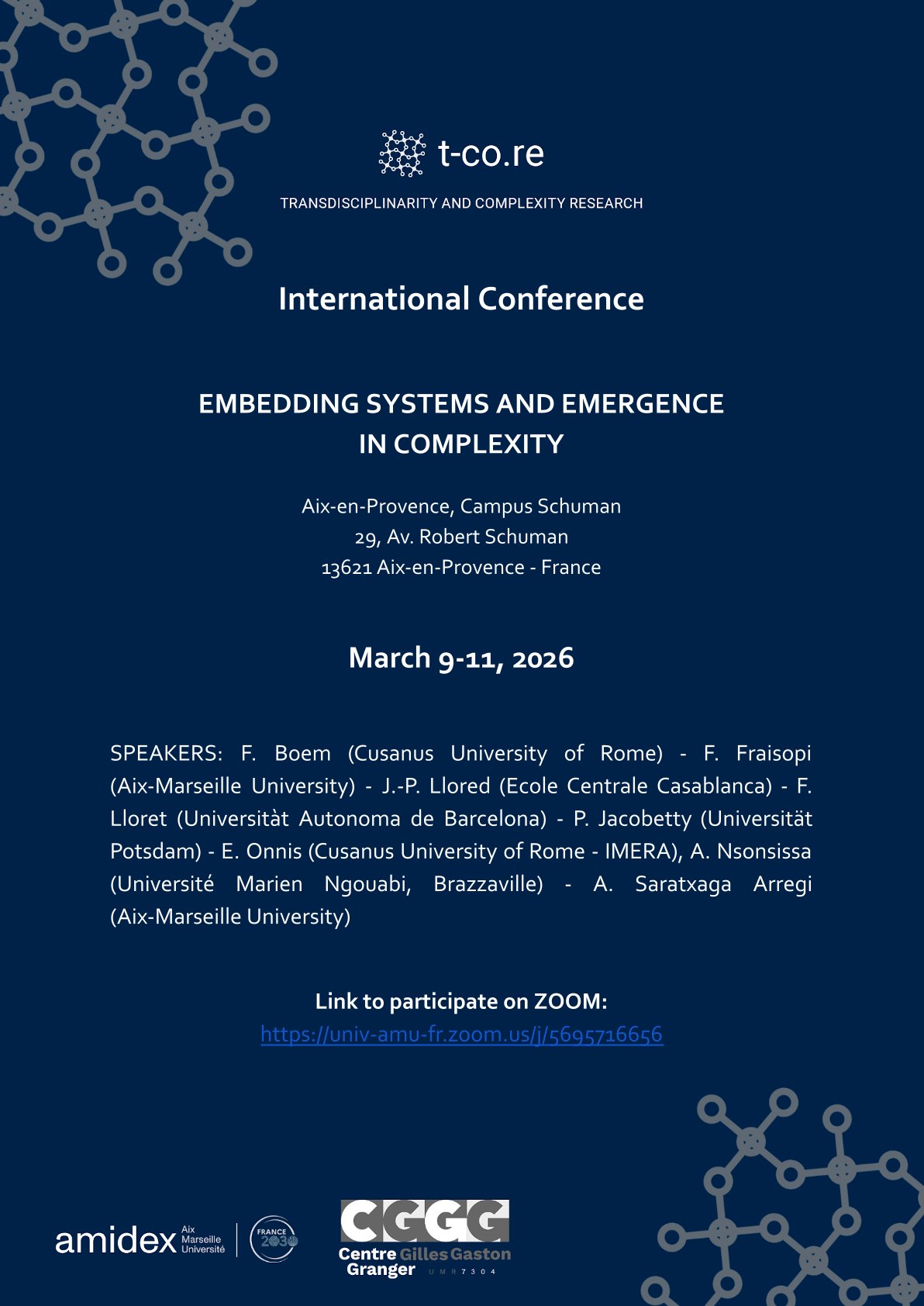
Embedding Systems and Emergency in Complexity
From 9 to 11 March, the “Embedding Systems” conference will be held as part of the AMIDEX Excellence Chair Project, “Transdisciplinarity and Complexity Research at Aix-Marseille University”.
The aim of the conference is to investigate the concept of embedding of a system within its environment, examining it in relation to the emergence of complex structures, both as a thesis and as a research hypothesis. This perspective potentially shifts the focus of emergence from the system itself to the environment in which it is embedded.
This approach can be explored across multiple disciplines, including studies of living systems, ecology, and computer science. Accordingly, the conference will combine formal presentations with discussions and interdisciplinary exchanges. These exchanges will take place through structured discussion rounds, walks, and targeted methodological sessions. We would like to emphasize that learning from one another is just as important as presenting one’s own work.Participants: Dr Pedro Jacobetty (Digital Sociology), University of Potsdam, Prof. Francisco Lloret (Ecological Research and Forest Applications), Autonomous University of Barcelona (UAB)/Center for Ecological Research and Forest Applications (CREAF), Prof. Jean-Pierre Llored (Chemistry and Philosophy), Fondation École Centrale Casablanca & Department of Humanities and Social Sciences, École CentraleSupélec, Dr Federico Boem (Biology), Ruhr University, Prof. Erica Onnis (Philosophy), IMERA, Dr. Arantzazu Saratxaga (Philosophy), Aix-Marseille University
More information: https://www.tcore-chair-amu.fr/agenda/embedding-systems-and-emergence-in-complexity/
-

Reading Group: Process and Reality. An Essay of Cosmology.
Whitehead’s process philosophy presents a dynamic ontology in which reality is understood as a network of unfolding events rather than static substances. This view aligns with complexity theory, which studies emergent, nonlinear and adaptive systems. Both approaches emphasise relationality, processuality and becoming over being. Rather than appearing as a closed whole, reality is seen as an ongoing, creative process characterised by interactions. Complexity theory provides an epistemological framework through which Whitehead’s metaphysical concepts can be interpreted in a systemic and interdisciplinary manner. This connection enables a deeper understanding of living systems, social dynamics and ecological processes, promoting holistic perspectives on reality and knowledge.
January – December 2026
(4:30 PM): 23.01 – 20.02 – 20.03 – 17.04 – 22.05 – 19.06 – 24.07 – 21.08 – 18.09 – 23.10 – 20.11 – 18.12 -
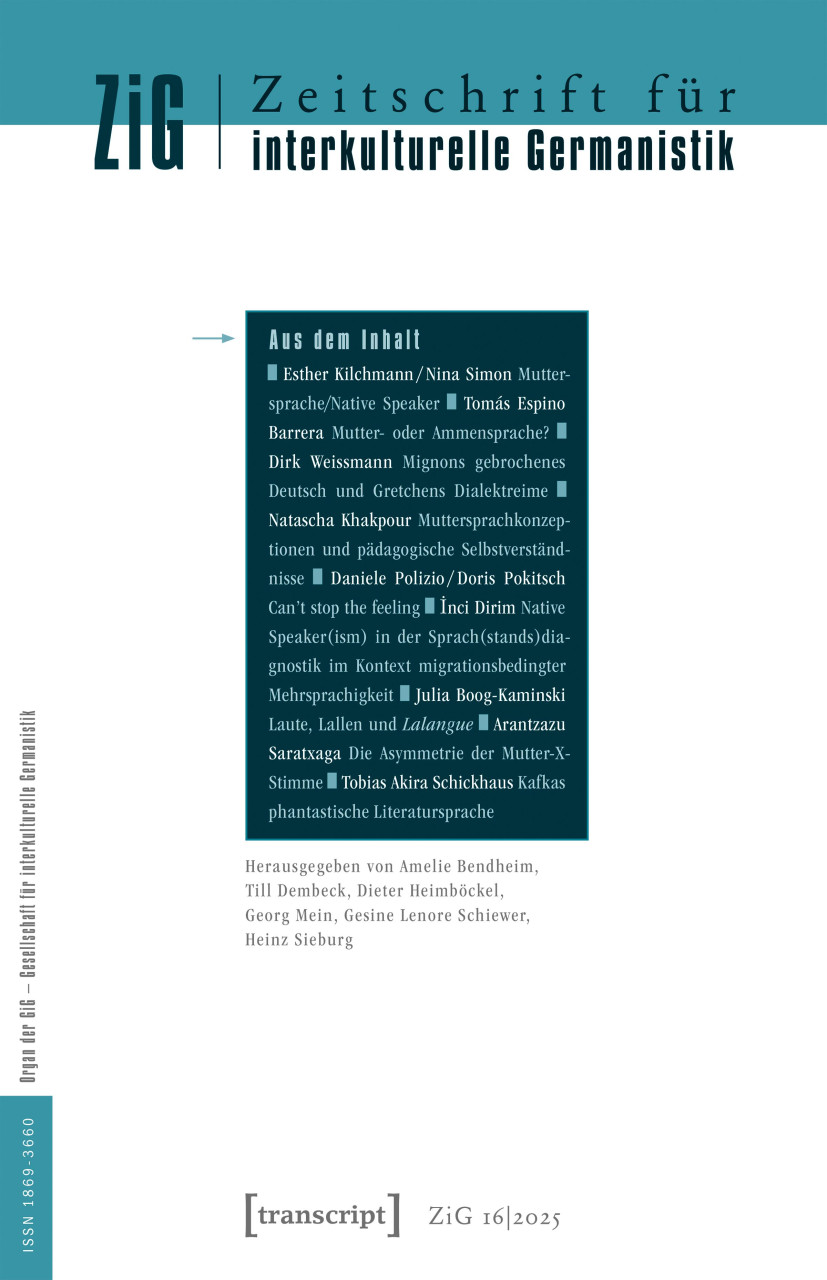
Artikel: „Die Asymmetrie der Mutter-X Stimme“.
This essay uses a philosophical-hermeneutic reading of the Oracle of Delphi’s heralds to portray the mother’s voice as a failed beginning, creating an asymmetry in communication.
The ancient Pythiae, who received and transmitted the divine voice, are associated with the art of divination. In this essay, however, the reception of Mother Earth’s voice is attributed to a hermeneu- tics of listening. The Oracle of Delphi speaks from the earth’s locus, where the serpent Python, slain by Apollo, dwells. Priestesses receive messages from Mother Earth and convey them in the form of sayings, which priests and philosophers then translate and write down. The circle of communicati- on is maintained by the asymmetry of the ›mother‹ voice.Keywords: mother voice; hermeneutics; oracle; divination; listening
https://doi.org/10.14361/zig-2025-160111
-
Rezension: „Informationsströmein digitalen Kulturen. Theoriebildung, Geschichte und logistischer Kapitalismus“von Matthias Denecke
Medienimpulse ISSN 2307-3187
Jg. 63, Nr. 4, 2025 doi: 10.21243/mi-04-25-14Ausgehend von der Hauptthese der Monografe „Informations- ströme in digitalen Kulturen. Theoriebildung, Geschichte und lo- gistischer Kapitalismus“ von Matthias Denecke, einer Kritik an der Metaphorologisierung des Wortes „Strom“ zugunsten der Le- gitimierung des Diskurses über die digitale Kultur, thematisiert dieser Review Essay die Anwendung des Begrifs „Strom“ zur Be- schreibung von Kreisläufen und deren Metaphorisierung zu- gunsten der kapitalistischen Informationsgesellschaft. Ergänzt wird dies durch den Vorschlag, statt von Metaphern von Met- onymien zu sprechen, denn „Strom“ steht nicht für die Beschreibung eines Gleichgewichts. Im Gegenteil: Fließen kann wie ein Wirbel disruptiv wirken. Vor allem ist mit „Strom“ die Dynamik der Nichtlinearität in Vorgängen gemeint, die auf unkontrollierte Art und Weise erfolgen können.
This text is a detailed review essay of the monograph “Informati – onsströme in digitalen Kulturen. Theoriebildung, Geschichte und logistischer Kapitalismus (Information fows in digital cultures. Theory formation, history and logistical capitalism)” by Matthias Denecke. Based on the book’s main thesis – a critique of the use of the metaphor ‘stream’ to legitimise discourse on digital cul- ture – this review addresses the use of the term ‘stream’ to des- cribe cycles and their metaphorisation to serve the capitalist in- formation society. The review supplements the suggestion to speak of metonymies rather than metaphors because ‘fow’ does not describe an equilibrium. In fact, ‘fow’ can have a disruptive efect, like a vortex. Above all, ‘fow’ refers to the dynamics of nonlinearity in processes that can occur in an uncontrolled manner.
-
Conversation: „Art, Complexity and Uncertainty: a conversation with David Familian“.
Read the fascinating interview with curator and artist David Familian about art and complexity here!
Yearbook for Philosophy of Complex Systems, 1 (2025): 235 – 248 https://doi.org/10.3790/pcs.2025.1461904
-

A course on complexity as a part of: „Forests as complex systems field course“
Teaching theoretical concepts, such as resilience or complexity theory, provides unique challenges especially in applied disciplines. Current trends such as global change will require natural resource disciplines, such as forestry and agriculture, to expand their scientific basis and possibly shift their dominant paradigms to adopt a broader view of the systems they manage as complex social-ecological systems. This likely will result in borrowing and adapting theories and concepts from other disciplines, such as complexity science. Students in natural resources will need more training in these paradigms and learn to incorporate concepts such as thresholds, uncertainty, and cross-scale interactions as they affect ecosystem dynamics into management or restoration prescriptions. Numerous courses and approaches exist that teach general complexity concepts, including management implications at the governance levels. However, we do not know of any courses where these concepts are specifically applied to practical management challenges. This course aims to overcome this shortcoming by providing field exercises that can are used to link theoretical concepts from complexity science to applied forest management issues regardless of management objectives.
-
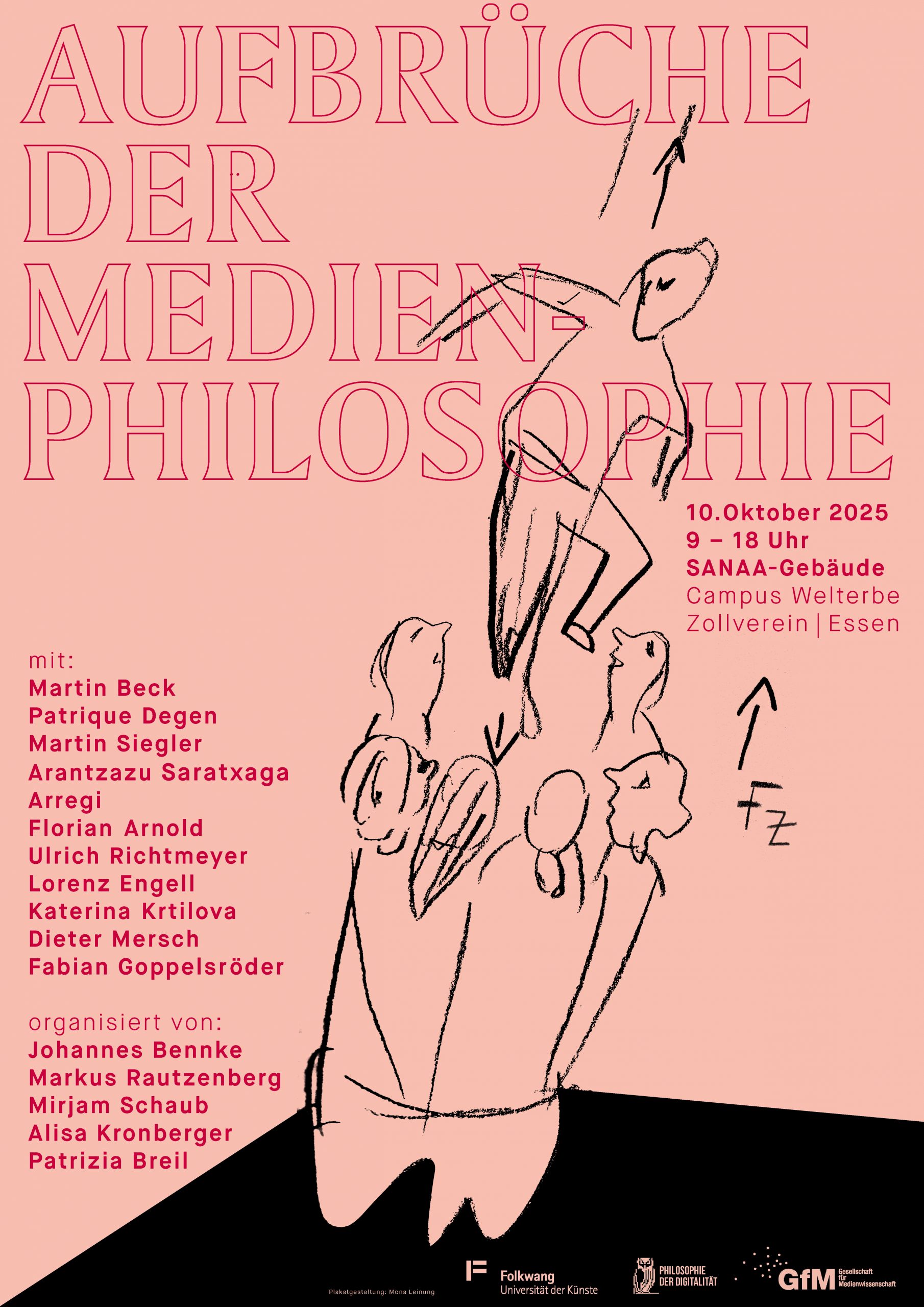
Vortrag: “Der Kreislauf: Das Pharmakon der Asymmetrien. Eine technikphilosophische Lesart des Verhältnisses von Zirkularität und Entropie”
Es ist ein Vergnügen, an der Veranstaltung „Aufbrüche der Medienphilosophie” teilzunehmen, insbesondere an dem Vortrag „Der Kreislauf: Das Pharmakon der Asymmetrien”. Eine technikphilosophische Lesart des Verhältnisses von Zirkularität und Entropie” teilnehmen zu dürfen!
Programm
-
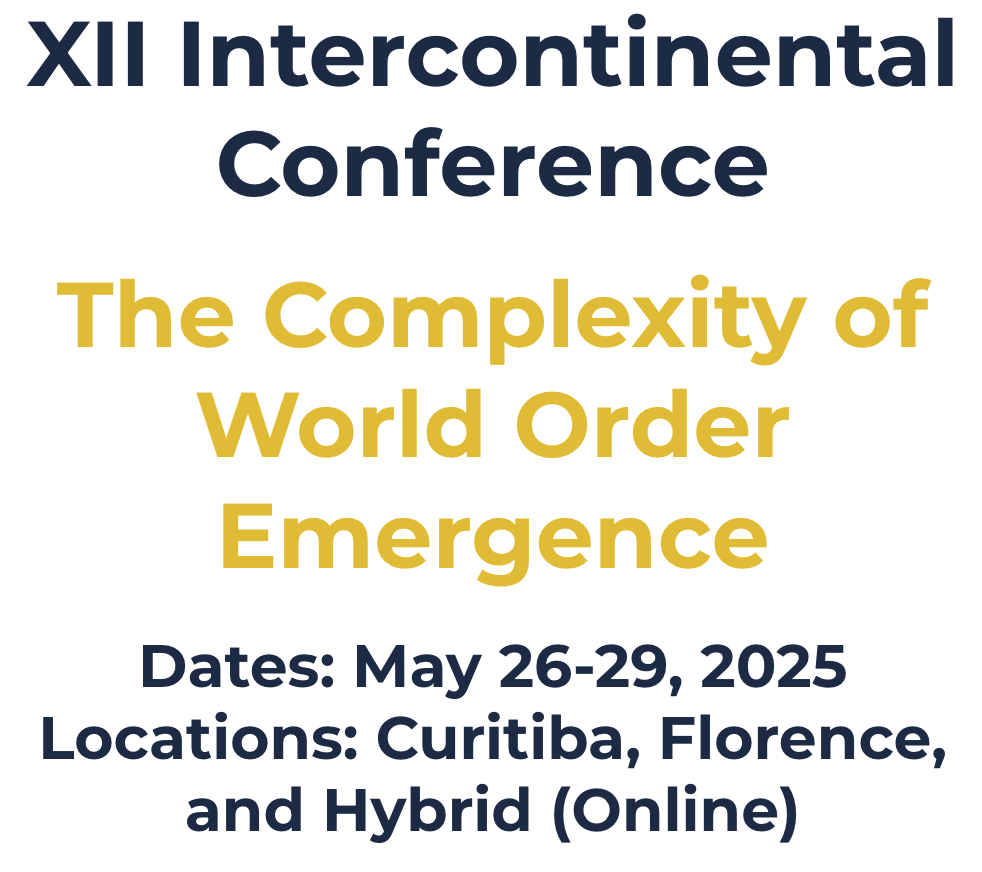
Lecture: “Emergence through environmental embedding.”
I am delighted to present my lecture, ‚Emergence through Environmental Embedding‘, at the XII Intercontinental Conference, ‚The Complexity of World Order Emergence‘, organised by the World Complexity Science Academy (WCSA).
Abstract
The aim of my presentation is to present the philosophical theories to understand the phenomenon of emergence, not as the matter itself, but as the (self-)organisation of the system. The organisation of the system arises from the relational correlation between system and environment, in such a way that the emergence can also be successful, under condition of embedding in the system. The ecological relational of embedding is the principle of generation of structures or emergence of patterns.
The ontological analysis of the concept of emergence shows that only the embedding of emergent properties in certain emergent levels or layers enables the permanent emergence of new structures. Conversely, the singular appearance of any new thing as an object, property, or structural element would only be an irrelevant variation of the given, which occurs constantly and everywhere anyway. The resulting ontological questions are, for example What is an emergent level? How do individual variations of the given gradually coalesce into emergent properties and objects? How can the relationship between different emergent levels be described?
The ontological approach to the study of emergence is thus holistic in nature, i.e. it sees the whole of a structural section of the world as the actual carrier of emergence. If we assume that emergence is a certain kind of event, i.e. a process, then emergence theory falls within the realm of general process philosophy. It follows that general process conditions, i.e. those that apply to any conceivable process, must also apply to emergent processes. Emergence as a structural phenomenon can thus be understood as a differentiation of antecedent process conditions.
-
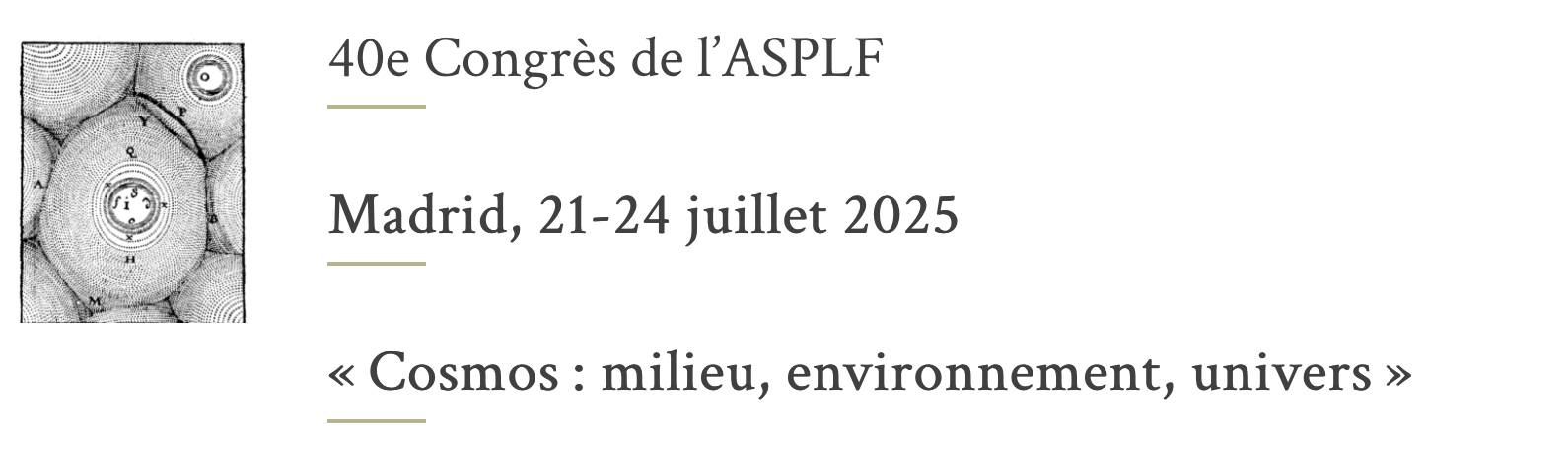
Lecture: “L’Endomilieu: : L’intérieur est l’extérieur du système”
It is a pleasure to present my lecture, „L’Endomilieu: The Interior is the Exterior of the System” at the 40th ASPLF Congress, “Cosmos: milieu, environment, univers,” at the Autonomous University of Madrid.
Abstract
The topic of this paper is an explanation of the inside/outside relation between the milieu and the system.
I would like to place this discussion in the midst of two seemingly opposing views: On the one hand,
the post-structuralist legacy of Foucault, along with the concept of environment of Deleuze and Guattari,
who have assigned the latter towards an outside, and on the other hand, the concept of milieu of theories
of operational closure (Heinz von Foerster, Niklas Luhmann, Gotthard Günther, etc), according to which
the milieu is placed inside the system.
The concept of environment represents an outside for both ecological studies and general systems
theory. It is regarded as an outside that interacts with the system. The self-organization theories initiated
a turn in the system/environment paradigm. Milieu or environment are no longer introduced into the
order of observation as the outside, but only through their difference from the system or, in other words,
via the opposition of system/environment. Through the dialectical method of re-entry, operative theories
assume that there is no longer an outside, and if there is, it is introduced into the system as a blind spot.
Thus, self-organization theories that have formulated openness to the outside and closure to the inside
and provided formalization accodringly, contribute to the abolition of the concept of outside. The
dissolution of an external objective reality is realized in exchange for an omnipotent subject that can see
or observe everything. The inside of the system becomes the outside for self-organization theories as
soon as it turns into a blind spot. The inside of a system, the black box that controls it and simultaneously
classifies its input, forms the unpredictable outside of the observer.
A dialogue between post-structuralist positions on the outside of thinking in combination with the
approaches of the disappearance of the outside in the operative theories can be very fruitful for today’s
conversations about an increasingly complex world and its means to observe its epistemology. -

Presentation on „Shapes of Complexity. Crossing Perspectives“
It is a pleasure to present my project „Epistemologies of Compleixty: contingency of order, asymmetry of time, irreducibility of uncertainty“ in excellence chair, „Transdisciplinarity and complexity Research at the Aix- Marseille Université
-

Yearbook for Philosophy of Complex Systems (PCS)
New at Duncker & Humblot from 2025!
Edited by Arantzazu Saratxaga Arregi und Fausto Fraisopi
-

HEINZ VON FOERSTER’S OPERATIONAL EPISTEMOLOGY: ORIENTATION ENCLAVES FOR INSIGHT INTO COMPLEXIT
https://www.emerald.com/insight/content/doi/10.1108/K-10-2023-2116/full/html
Kybernetes, Vol. ahead-of-print No. ahead-of-print. https://doi.org/10.1108/K-10-2023-2116
-
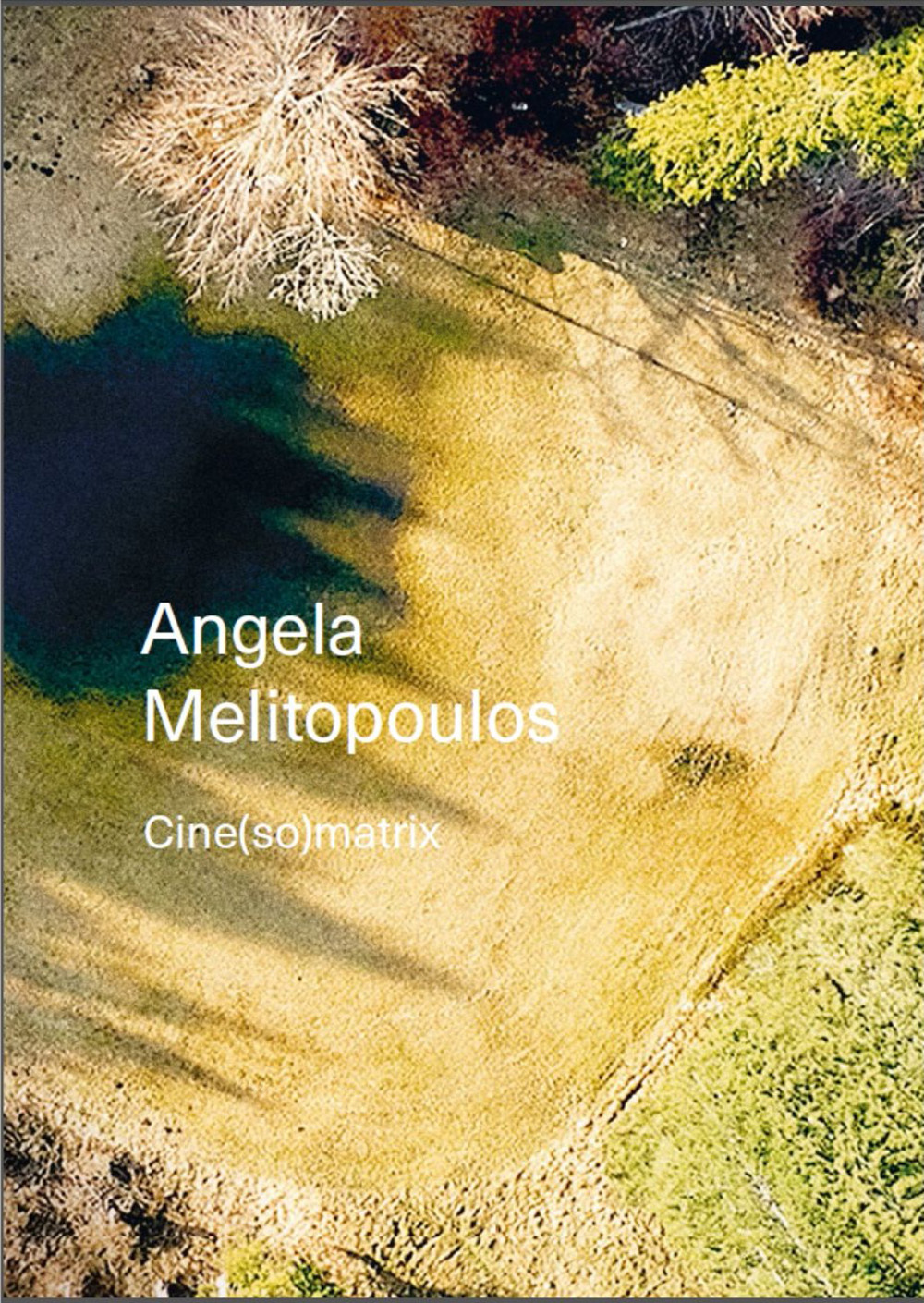
Essay: „When The Camera-Eye Descends into The Deep Earth and Speaks in The Language of Participation: Matrixial Weaving for Political Autonomy“
https://www.museoreinasofia.es/publicaciones/angela-melitopoulos
Angela Melitopulos, Cine(so)matrix.
Museo Reina Sofia -
Rezension im erweiterten Forschungskontext: Yuk Hui (Hg.): Cybernetics 21st Century: Epistemological Reconstuction
Arantzazu Saratxaga Arregi
REZENSION IM ERWEITERTEN FORSCHUNGSKONTEXT Yuk Hui (Hg.): Cybernetics for the 21st Century: Epistemological Reconstruction
2025
https://doi.org/10.25969/mediarep/23886 -
JACOB TAUBE’S REDE VON DER ESCHATOLOGIE IN REVISION
https://www.lit-verlag.de/isbn/978-3-643-15100-1
Julian Kiefer, Christian Loos (Hg.) Geschichtsphilosophie und Eschatologie. Perspektiven nach Jacob Taubes.
LIT Verlag -
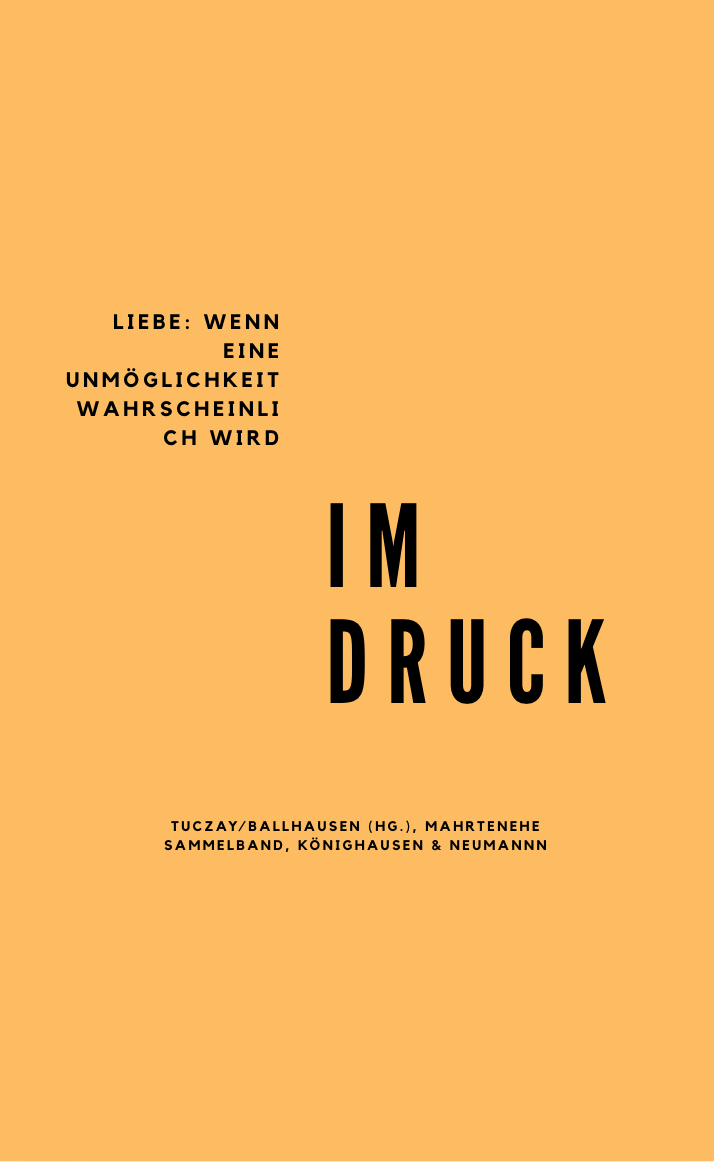
LIEBE: WENN EINE UNMÖGLICHKEIT WAHRSCHEINLICH WIRD.
Christa A. Tuczay/Thomas Ballhausen (Hg):MAHRTENEHE.
Königshausen & Neuman.
(Im Druck)