This proposal outlines a collaboration within the ASC framework to create a collective working space leading to a joint publication. The project explores the emancipatory potential of second-order cybernetics as a response to the epistemological foundations of contemporary algorithmic governance.
Algorithmic governance rests on the assumption that reality is objectively given, fully modelable, and manageable through computation. This premise shifts epistemic authority to algorithmic systems, treated as neutral producers of comprehensive knowledge. The dominance of AI depends on the belief that algorithmic models generate objective truth. Consequently, power is delegated to systems that claim neutrality while concealing their selective operations. A “God’s eye” perspective emerges, legitimizing algorithmic authority not only through performance but through an attributed status of objectivity and omniscience. The track challenges this logic through second-order operative epistemology. Rather than presuming objectivity, second-order cybernetics observes observation itself. It emphasizes that every observation is selective and entails blind spots. Knowledge arises not from representing reality but from reflecting on how observations are constructed. This perspective questions the promises of transparency, automation, and total control.
The track will address central epistemological tensions: observation versus representation; self-organization versus algorithmic determinism; transparency versus the blind spot of observation; communication versus control; reflexivity versus automation; and uncertainty versus the illusion of total calculability.
Drawing on cybernetic operative knowledge, the track aims to critically examine the epistemological foundations of algorithmic power, expose their fragility, and open alternative spaces for thought and action, laying the groundwork for a subsequent joint publication.
Das Seminar untersucht das „Generative“ als ästhetischen Leitbegriff mit besonderem Fokus auf die Form. Im Zentrum steht die Frage, wie Form im Kontext generativer Prozesse entsteht und wie sich dieses Entstehen beobachten, denken und zur Sprache bringen lässt. Generative Kunst verschiebt die Aufmerksamkeit vom abgeschlossenen Werk auf den Prozess der Hervorbringung von Bild- und Strukturformationen. Form erscheint dabei nicht als Abbild oder Repräsentation einer Idee (eidos), sondern als emergente Gestalt, die sich im Vollzug komplexer Prozesse konstituiert.
Ausgehend von einer kritischen Analyse hylemorphistischer und substanzontologischer Formkonzeptionen – Form als eidos oder als die Materie (hylé) in-formierende Idee – entwickelt das Seminar eine nicht-repräsentationale und relationale Theorie der Form. Form wird als situierte Stabilisierung komplexer Prozesse verstanden: als Muster, das aus Rückkopplung, Resonanz und Wechselwirkung hervorgeht. Sie ist keine statische Struktur, sondern eine zeitlich gebundene, dynamische und „merkende“ Konfiguration innerhalb komplexer Systeme. Form erscheint somit als emergentes Ereignis, das sich im Verlauf der Zeit transformiert. Reflektiert werden eine Ästhetik des Verschwindens, der Instabilität und der Transformation ebenso wie Gestaltung als Ermöglichung von Emergenz.
Theoretisch verbindet das Seminar philosophische Perspektiven (Differenzphilosophie, Systemtheorie, Phänomenologie, feministischer Materialismus) mit ästhetischen Theorien, insbesondere der generativen Ästhetik, sowie mit Bezügen zur ästhetischen Gestalttheorie (Rudolf Arnheim). Ergänzend werden kunst- und medienhistorische Positionen einbezogen: im Kontext generativer Gestaltung George Nees, Frieder Nake und Manfred Mohr, im Feld generativer Kunst Herbert W. Franke. Darüber hinaus werden Referenzen zum Konstruktivismus, zur Konkreten Kunst, zum Bauhaus, zur Lichtkunst (László Moholy-Nagy), zur Netzwerkkunst sowie zu Arbeiten von Victor Vasarely, Gerhard von Graevenitz, Herman de Vries und Myron Krueger hergestellt.
Präsentation 15.05. (14:00 Uhr–18:00 Uhr)
Form und Eidos und ihre Dekonstruktion 22.05. (10:00 Uhr–18:00 Uhr) 23.05. (10:00 Uhr – 14:00 Uhr)
Prozesualität der Form – Gestalttheorie in der Kunst & Paradoxien der Form 11.06. (14:00 Uhr–18:00 Uhr) 12.06. (10:00 Uhr–18:00 Uhr)
Belting, Hans: Bild-Anthropologie. Entwürfe für eine Bildwissenschaft. München: Wilhelm Fink Verlag, 2001.
Belting, Hans / Dilly, Heinrich / Kemp, Wolfgang (Hg.): Kunstgeschichte. Eine Einführung. Berlin: Reimer Verlag, 1985.
Cassirer, Ernst: Die Philosophie der Aufklärung. Tübingen: Mohr Siebeck, 1932.
Coccia, Emanuele: Das Leben der Formen.
Coccia, Emanuele: Das sinnliche Leben. Berlin: Matthes & Seitz, 2018.
Coccia, Emanuele / Bense, Max: Schalten und Walten. Karlsruhe: ZKM.
de Man, Paul: Aesthetic Ideology. Minneapolis: University of Minnesota Press, 1996.
Derrida, Jacques: Die Wahrheit in der Malerei. Wien: Passagen Verlag, 1992.
Didi-Huberman, Georges: Was wir sehen blickt uns an. Zur Metapsychologie des Bildes. München: Wilhelm Fink Verlag, 1999.
Jauß, Hans Robert: Ästhetische Normen und geschichtliche Reflexion in der „Querelle des Anciens et des Modernes“. München: Wilhelm Fink Verlag, 1964.
Merleau-Ponty, Maurice: Das Auge und der Geist. Hamburg: Meiner Verlag, 2003.
Merleau-Ponty, Maurice: Phänomenologie der Wahrnehmung. Berlin: Walter de Gruyter, 1966.
Rancière, Jacques: Das ästhetische Unbewusste. Zürich/Berlin: Diaphanes, 2006.
Wölfflin, Heinrich: Kunstgeschichtliche Grundbegriffe. Das Problem der Stilentwicklung in der neueren Kunst. München: Bruckmann, 1915.
Referenzierte Texte
I. Sitzung
Adorno, Theodor W.: Ästhetische Theorie. Frankfurt am Main: Suhrkamp, 1970.
Baumgarten, Alexander Gottlieb: Philosophische Betrachtungen über einige Bedingungen des Gedichts (Meditationes philosophicae de nonnullis ad poema pertinentibus). Halle: Hemmerde, 1735.
Bennett, Jane: Vibrant Matter. A Political Ecology of Things. Durham/London: Duke University Press, 2010.
Deleuze, Gilles / Guattari, Félix: Tausend Plateaus. Kapitalismus und Schizophrenie II. Berlin: Merve Verlag, 1992.
Hildebrand, Adolf von: Das Problem der Form in der bildenden Kunst. Straßburg: Heitz, 1893.
Langer, Susanne K.: Fühlen und Form. Eine Theorie der Kunst. Frankfurt am Main: Fischer Verlag, 1987.
Malabou, Catherine: La plasticité au soir de l’écriture. Dialectique, destruction, déconstruction. Paris: Léo Scheer, 2004.
Riegl, Alois: Stilfragen. Grundlegungen zu einer Geschichte der Ornamentik. Berlin: Georg Siemens, 1893.
Simondon, Gilbert: L’individuation à la lumière des notions de forme et d’information. Grenoble: Millon, 2005.
Zimmermann, Robert: Allgemeine Ästhetik als Formwissenschaft. Wien: Braumüller, 1865.
II. Sitzung
εἶδος (eidos) und μορφή (morphē)
Aristoteles: Analytica posteriora. Übers. und hg. von Wolfgang Detel. Berlin: Akademie Verlag, 1993.
Aristoteles: Metaphysik. Übers. und hg. von Horst Seidl. Hamburg: Meiner Verlag, 1980.
Aristoteles: Physik. Übers. und hg. von Hans Günter Zekl. Hamburg: Meiner Verlag, 1987.
Foucault, Michel: Die Ordnung der Dinge. Eine Archäologie der Humanwissenschaften. Frankfurt am Main: Suhrkamp, 1974.
Platon: Euthyphron. In: Sämtliche Werke, Bd. 1. Übers. von Friedrich Schleiermacher. Reinbek bei Hamburg: Rowohlt, 1994.
Platon: Phaidon. In: Sämtliche Werke, Bd. 2. Übers. von Friedrich Schleiermacher. Reinbek bei Hamburg: Rowohlt, 1994.
Platon: Politikos (Der Staatsmann). In: Sämtliche Werke, Bd. 6. Übers. von Friedrich Schleiermacher. Reinbek bei Hamburg: Rowohlt, 1994.
Platon: Sophistes. In: Sämtliche Werke, Bd. 6. Übers. von Friedrich Schleiermacher. Reinbek bei Hamburg: Rowohlt, 1994.
Zwischen den Formen der Natur, des Geistes und des Kunstwerks: Das Problem der Nachahmung und Mimesis
Alberti, Leon Battista: Drei Bücher über die Malerei (De pictura). Übers. und hg. von Oskar Bätschmann und Christoph Schäublin. Darmstadt: Wissenschaftliche Buchgesellschaft, 2002.
Burke, Edmund: Philosophische Untersuchung über den Ursprung unserer Ideen vom Erhabenen und Schönen (A Philosophical Enquiry into the Origin of Our Ideas of the Sublime and Beautiful). Hamburg: Meiner Verlag, 1989.
Goethe, Johann Wolfgang: Einfache Nachahmung der Natur, Manier, Stil. In: Sämtliche Werke, Bd. 18. Frankfurt am Main: Deutscher Klassiker Verlag, 1999.
Hegel, Georg Wilhelm Friedrich: Vorlesungen über die Ästhetik. 3 Bde. Frankfurt am Main: Suhrkamp, 1986.
Herder, Johann Gottfried: Kalligone. Frankfurt am Main: Deutscher Klassiker Verlag, 2000.
Kant, Immanuel: Kritik der reinen Vernunft. Hamburg: Meiner Verlag, 1998.
Kant, Immanuel: Kritik der Urteilskraft. Hamburg: Meiner Verlag, 2001.
Leonardo da Vinci: Das Buch von der Malerei. Hg. und übers. von Marie Herzfeld. Jena: Eugen Diederichs, 1909.
Lessing, Gotthold Ephraim: Laokoon oder Über die Grenzen der Malerei und Poesie. Stuttgart: Reclam, 1987.
Winckelmann, Johann Joachim: Gedanken über die Nachahmung der griechischen Werke in der Malerei und Bildhauerkunst. Stuttgart: Reclam, 1986.
Symbolische Formen, Gestalttheorie und der 19.Jh
Cassirer, Ernst: Philosophie der symbolischen Formen. Bd. 3: Phänomenologie der Erkenntnis. Berlin: Bruno Cassirer, 1929.
Ehrenfels, Christian von: Über Gestaltqualitäten. In: Vierteljahrsschrift für wissenschaftliche Philosophie 14 (1890), S. 249–292.
Fechner, Gustav Theodor: Vorschule der Ästhetik. 2 Bde. Leipzig: Breitkopf & Härtel, 1876.
Kandinsky, Wassily: Über das Geistige in der Kunst, insbesondere in der Malerei. München: Piper Verlag, 1912.
Nietzsche, Friedrich: Über Wahrheit und Lüge im außermoralischen Sinne. In: Sämtliche Werke. Kritische Studienausgabe, Bd. 1. Hg. von Giorgio Colli und Mazzino Montinari. München: dtv / de Gruyter, 1980.
Wertheimer, Max: Untersuchungen zur Lehre von der Gestalt II. In: Psychologische Forschung 4 (1923), S. 301–350.
Die 20.Jh: Phänomenologie und die Geometrie des Geistes
Apollinaire, Guillaume: Die Maler des Kubismus. Ästhetische Betrachtungen (Les Peintres cubistes, 1913). Frankfurt am Main: Suhrkamp, 1989.
Bell, Clive: Art. London: Chatto & Windus, 1914.
Brassaï: Gespräche mit Picasso. Frankfurt am Main: Suhrkamp, 1966.
Gropius, Walter: Idee und Aufbau des Staatlichen Bauhauses. München: Albert Langen Verlag, 1923.
Husserl, Edmund: Formale und transzendentale Logik. Hamburg: Meiner Verlag, 1978.
Husserl, Edmund: Ideen zu einer reinen Phänomenologie und phänomenologischen Philosophie. Erstes Buch. Husserliana III/1. Den Haag: Nijhoff, 1976.
Malewitsch, Kasimir: Die gegenstandslose Welt (Die Welt als Ungegenständlichkeit). München: Bauhausbücher, 1927.
Merleau-Ponty, Maurice: Das Sichtbare und das Unsichtbare. München: Fink Verlag, 1986.
Merleau-Ponty, Maurice: Phänomenologie der Wahrnehmung. Berlin: Walter de Gruyter, 1966.
Mondrian, Piet: Der Neoplastizismus (Le Néo-Plasticisme, 1920). In: Harry Holtzman / Martin S. James (Hg.): The New Art – The New Life: The Collected Writings of Piet Mondrian. Boston: G. K. Hall, 1986.
III. Sitzung
Postmodernität
Deleuze, Gilles: Logik des Sinns. Frankfurt am Main: Suhrkamp, 1993.
Derrida, Jacques: Die Stimme und das Phänomen. Einführung in das Problem des Zeichens in der Phänomenologie Husserls. Frankfurt am Main: Suhrkamp, 1979.
Derrida, Jacques: Grammatologie. Frankfurt am Main: Suhrkamp, 1983.
Derrida, Jacques: Randgänge der Philosophie. Wien: Passagen Verlag, 1988.
Malabou, Catherine: La plasticité au soir de l’écriture. Dialectique, destruction, déconstruction. Paris: Léo Scheer, 2004.
Kybernetik, Informationsästhetik, Generative Kunst & frühen Medienkunst
Bense, Max: Aesthetica. Einführung in die neue Ästhetik. Baden-Baden: Agis Verlag, 1965.
Foerster, Heinz von: Sicht und Einsicht. Versuche zu einer operativen Erkenntnistheorie. Braunschweig/Wiesbaden: Vieweg, 1985.
Glanville, Ranulph: Objects. London: Institute of Cybernetics, 1975.
Luhmann, Niklas: Die Form „Person“. In: Soziale Welt 42/2 (1991), S. 166–175.
Luhmann, Niklas: Die Kunst der Gesellschaft. Frankfurt am Main: Suhrkamp, 1995.
Luhmann, Niklas: Schriften zu Kunst und Literatur. Hg. von Niels Werber. Frankfurt am Main: Suhrkamp, 2008.
Moles, Abraham A.: Informationstheorie und ästhetische Wahrnehmung (Théorie de l’information et perception esthétique). Köln: DuMont, 1971.
Pask, Gordon: An Approach to Cybernetics. London: Hutchinson, 1961.
Spencer Brown, George: Gesetze der Form (Laws of Form). Lübeck: Bohmeier Verlag, 1997.
Weibel, Peter (Hg.): Jenseits von Kunst. Beiträge zur Kultur des Medienzeitalters. Wien/New York: Springer, 1997.
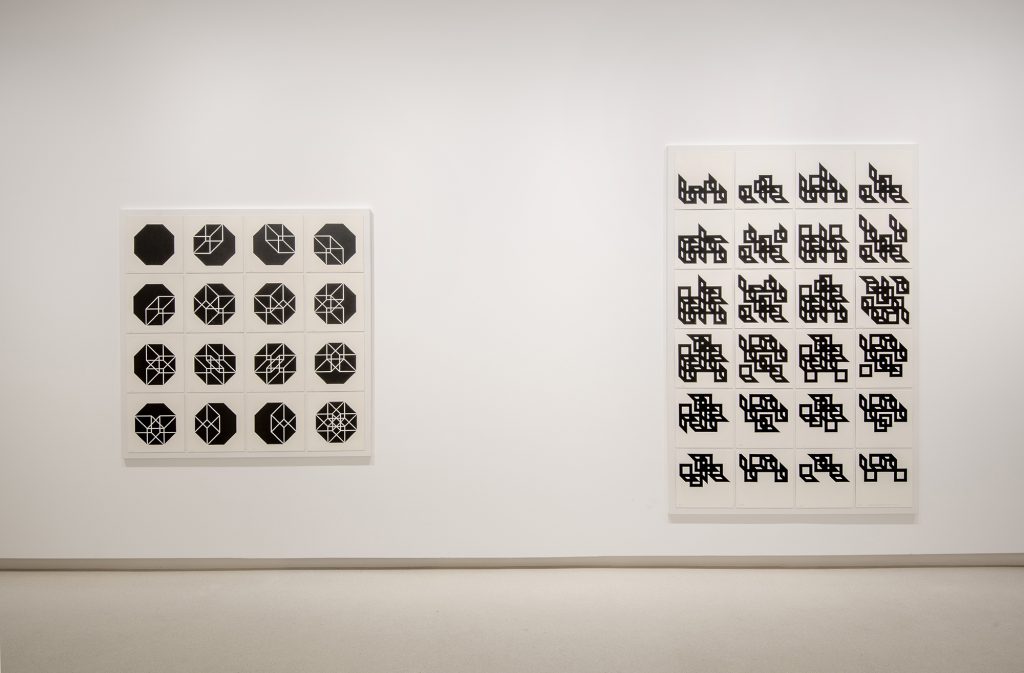
Aus Anlass meines neuelichen Aufenthalts im Baskenland – im Zusammenhang mit meinem Übersetzungsprojekt zu den ästhetischen Schriften Jorge Oteizas – begegnete ich, weniger zufällig als vielmehr in einem kairotischen Zeitpunkt, einer Ausstellung zum Werk von Elena Asins im Kubo Aretoa (Kursaal) in Donostia, kuratiert von Juan Pablo Huercanos. Die Ausstellung war großartig, hervorragend kuratiert – und ihre Entdeckung ein kleines Wunder. Was folgt, sind einige Überlegungen zu Elena Asins’ künstlerischer Laufbahn, ihrem Werk und den Fragen, die es durchziehen.
Elena Asins (Madrid, 2. März 1940 – Azpirotz, Navarra, 14. Dezember 2015) war eine bedeutende bildende Künstlerin und gehörte zur ersten Generation, die Computerkunst einsetzte.
Vom Expressionismus der Form zu geometrischen Gestaltungen
Die Sprache Mondrians erweist sich in ihrer essenziellen Reduktion als nahezu unvermeidlicher Ausgangspunkt für neue plastische Überlegungen. Unter seinem Einfluss entwickelte Elena Asins ein besonderes Interesse am Expressionismus der Form und wandte sich zunehmend geometrischen Gestaltungen zu, deren Grundlage Maß, Ordnung und räumliche Struktur bildeten.
„Mein Interesse an der gesamten geometrischen Gestaltung des Raumes lag vor allem in dessen Vermessung. Daher rührt auch die Betonung rein linearer Strukturen, die im Verlauf ihres Prozesses die Farbe nach und nach zurückdrängten.“
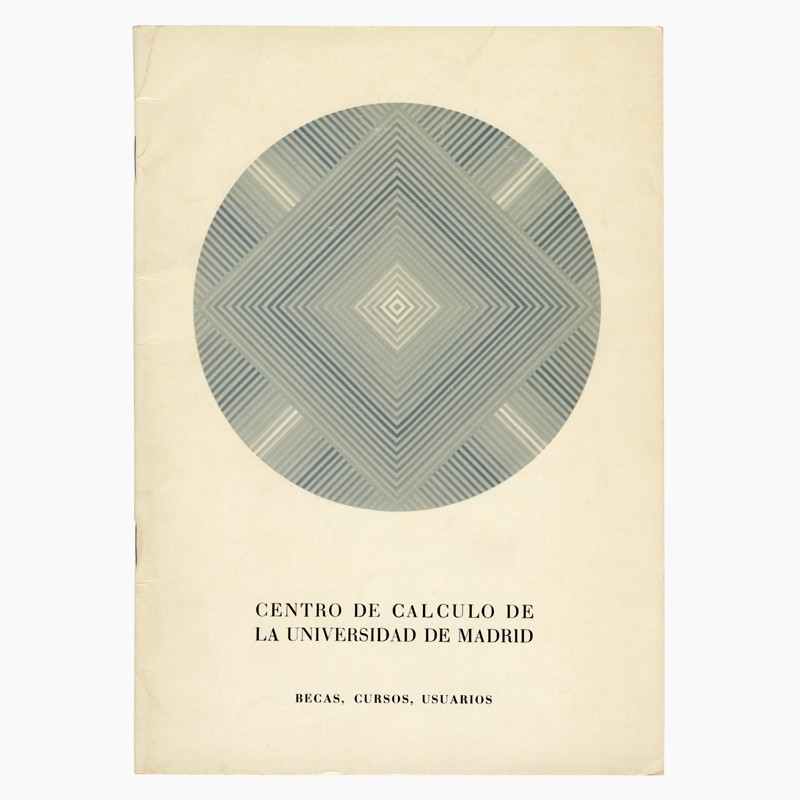
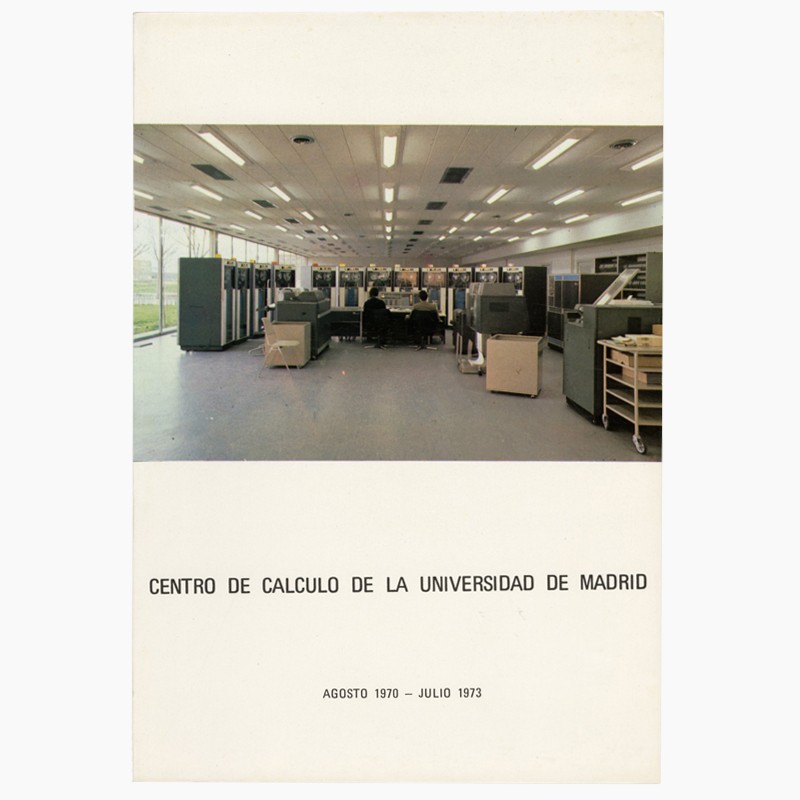
Rechenzentrum der Universität Complutense Madrid
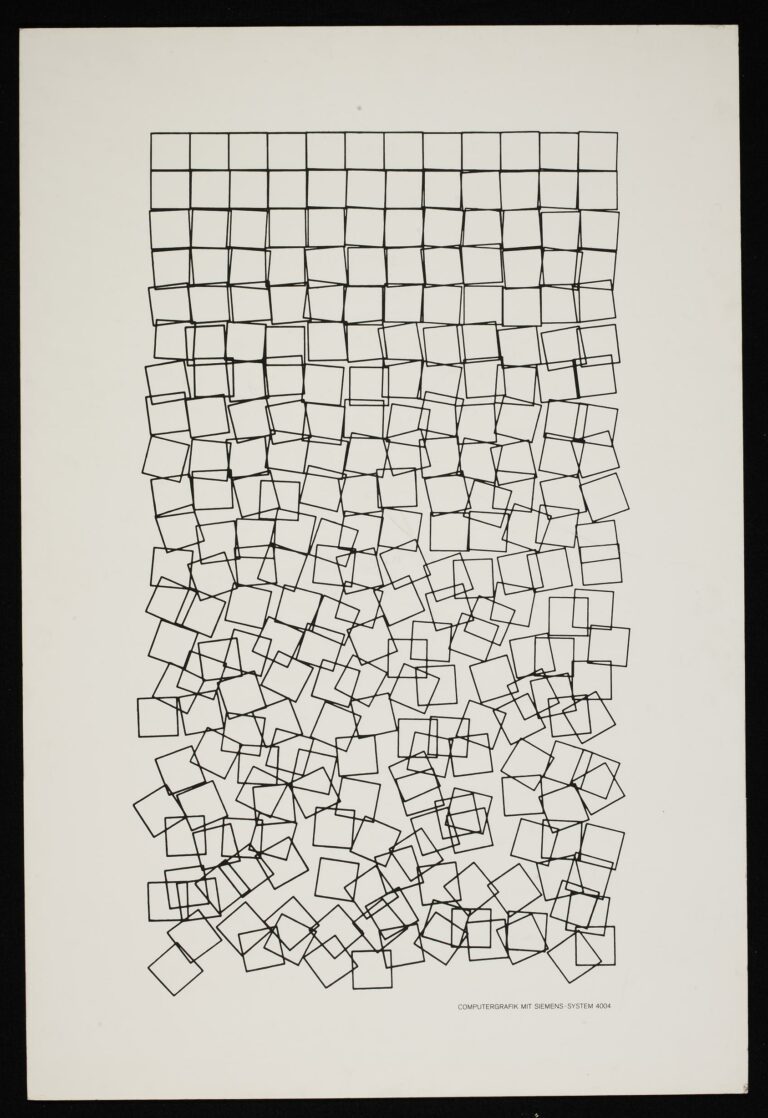
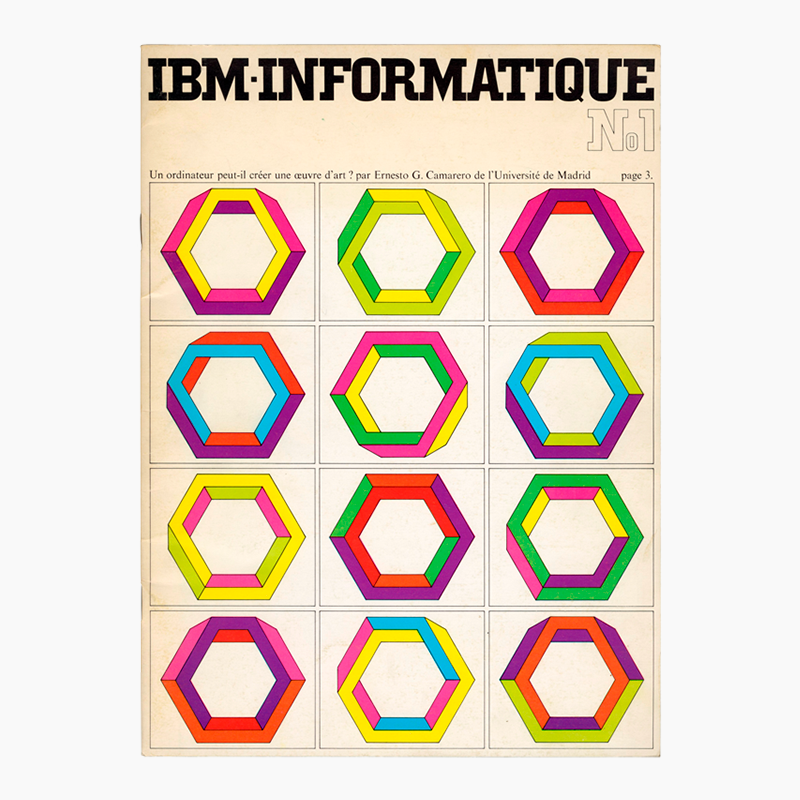
Bis 1968 war Elena Asins’ künstlerische Entwicklung wesentlich von der Suche nach Ordnung, Struktur und formaler Präzision geprägt. Einen entscheidenden Impuls erhielt sie in diesem Jahr am damaligen Rechenzentrum der Universidad Complutense in Madrid, wo Informatikseminare zur „automatischen Generierung plastischer Formen“ und zu „berechenbaren Formen“ ihre Fähigkeit zu Analyse, systematischer Ordnung und kontrollierter Strukturierung nachhaltig beeinflussten. Dabei setzte sie sich intensiv mit den Möglichkeiten algorithmischer Gestaltung auseinander und erhielt zugleich eine Ausbildung in computergestützter Logik, die für ihr späteres Werk grundlegend werden sollte..
Vom Expressionismus der Form zur seriellen Ordnung: Begegnung mit der Aesthetische Information Max Benses
In Stuttgart gewannen die zunächst noch diffusen Ideen der Informationstheorie konkrete Gestalt — in den Strukturen einer neuen seriellen Ordnung. Struktur und serielle Ordnung prägen das Werk von Elena Asins und stehen im Einklang mit der operativen Geschlossenheit computergestützter Algorithmen und ihrer iterativen Logik. Diskrete Zeichen und iterative Wiederholungen bestimmen eine mathematisch paradoxe Informationsgrammatik: in ihrer Organisation geschlossen, in ihrer Codierung jedoch offen. Genau diese informationelle Sprache wollte Asins in die bildende Kunst übertragen. Zwischen 1966 und 1973 widmete sie einen Teil ihrer Zeit der experimentellen Poesie und stand dabei in engem Kontakt mit Max Benses Aesthetica, seiner Abhandlung zur numerischen Ästhetik. Darin werden bestimmte „ästhetische Zustände“ beziehungsweise „ästhetische Realitäten“ mithilfe arithmetischer und statistischer Rechenschemata gestalttheoretisch und informationstheoretisch bestimmt, klassifiziert und messbar gemacht.
Für Asins bedeutete die Arbeit mit algorithmischen Strukturen weit mehr als eine bloße technische Methode. Sie verstand darin eine eigene Logik des Gestaltens — geprägt von Zirkularität, Iteration und differenzieller Wiederholung. Durch Schleifenprozesse und rekursive Verfahren entstehen fortlaufend neue Formen aus bereits erzeugten Strukturen; Linien entwickeln sich kontinuierlich weiter und eröffnen ein Spiel zwischen Ordnung, Variation und potenzieller Unendlichkeit.
Dieses Denken wurde unter anderem durch Ludwig Wittgensteins Bemerkungen über die Grundlagen der Mathematik (ca. 1937–1944) beeinflusst. Dort erscheint Mathematik nicht als abstraktes System ewiger Wahrheiten, sondern als eine Form von Grammatik: als Regelwerk, das den Gebrauch von Zeichen und Begriffen organisiert. Mathematische Axiome sind demnach weniger Repräsentationen von Ideen als vielmehr operative Strukturen innerhalb einer Sprache. In dieser Verbindung von Regel, Struktur und Offenheit fand Asins eine entscheidende theoretische Grundlage für ihr eigenes künstlerisches Arbeiten.
Kryptologie statt grafischer Kunst
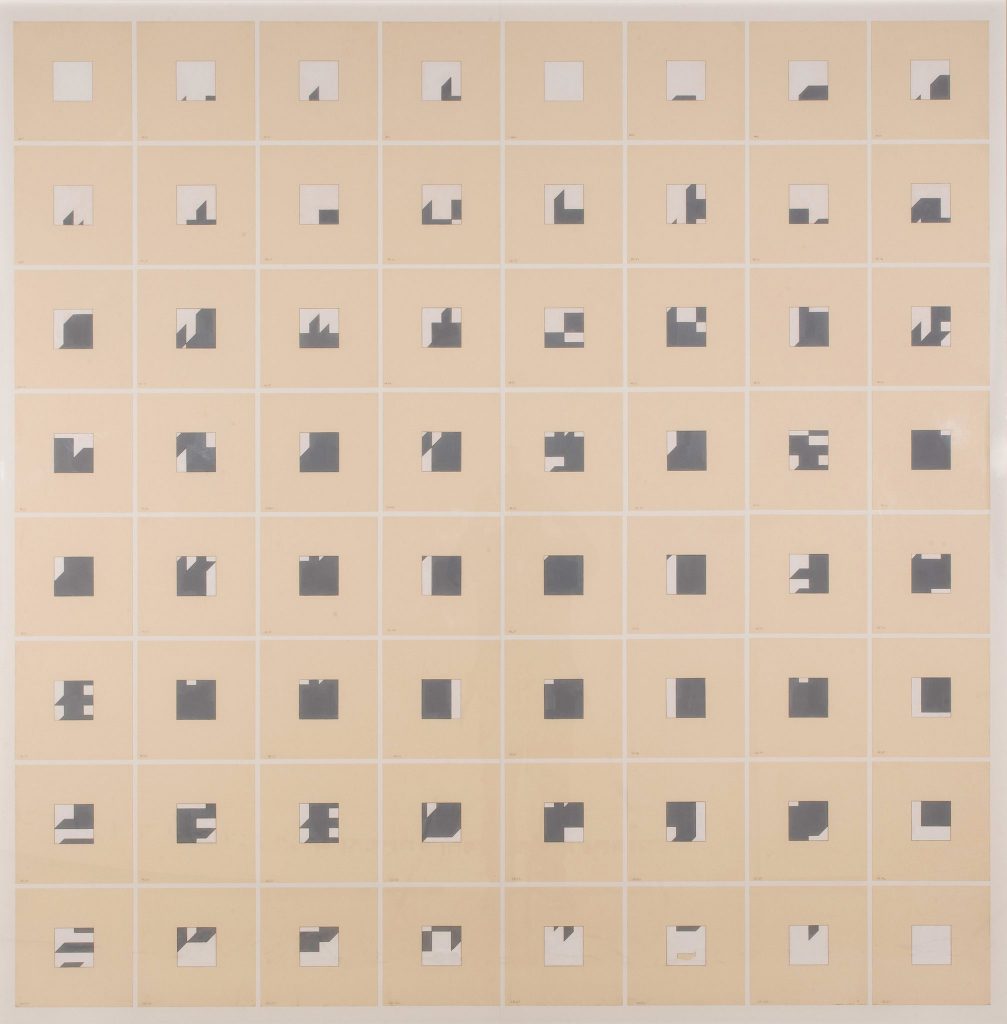
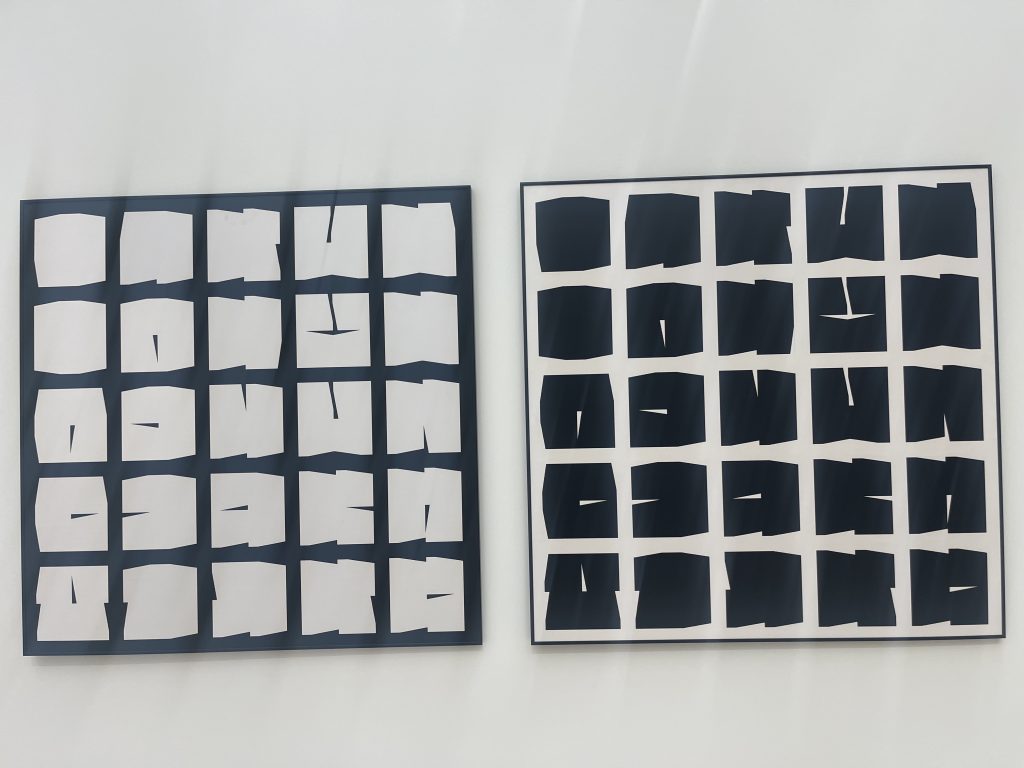
Elena Asins verstand ihre Arbeiten weniger als rein grafische Kompositionen denn als eine Form visueller Kryptologie. Diagramme, Zeichenfolgen und strukturierte Systeme durchziehen ihr gesamtes Werk und treten insbesondere seit ihrer Arbeit mit Computern deutlich hervor. Jedes Element besitzt für sie Bedeutung; selbst minimale Verschiebungen und kleinste Variationen tragen semantisches Gewicht. Kunst erscheint dabei nicht als durch Deutung entfremdetes Zeichen oder als von Natur und Leben getrennte ästhetische Oberfläche, sondern als Ausdruck einer den Dingen selbst innewohnenden Ordnung und Präzision, deren Bedeutung zu entziffern ist.
Menhir 2
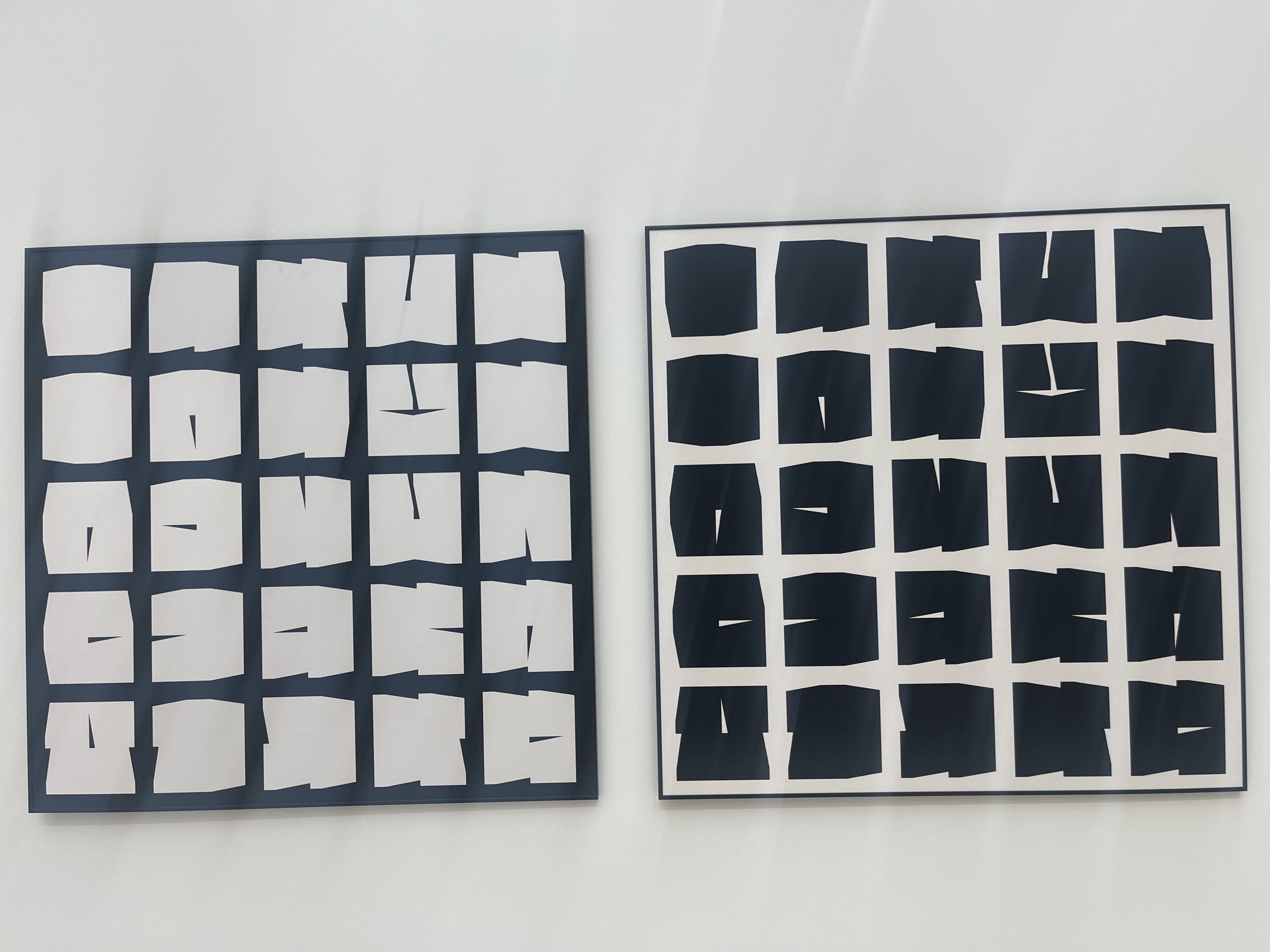
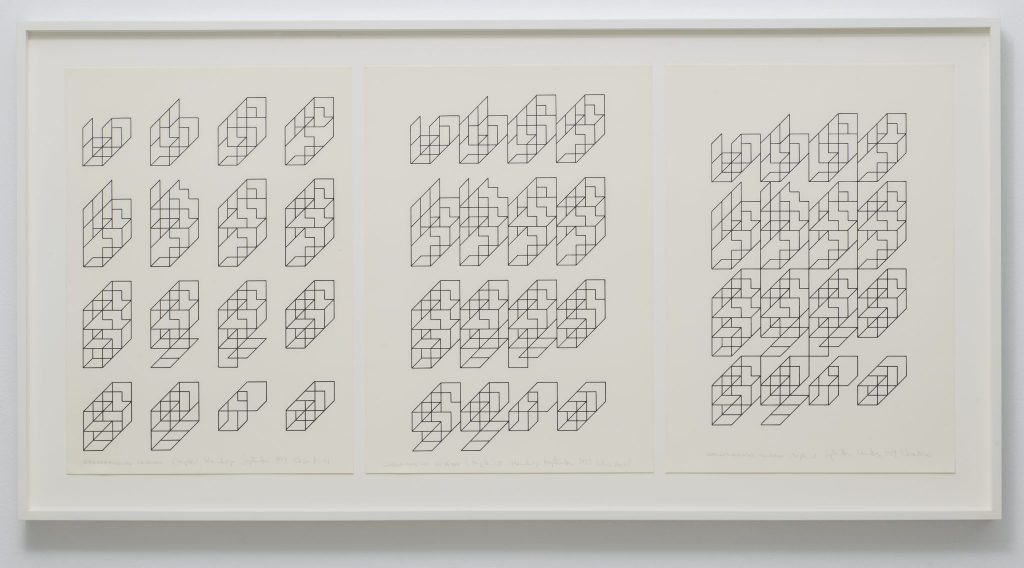
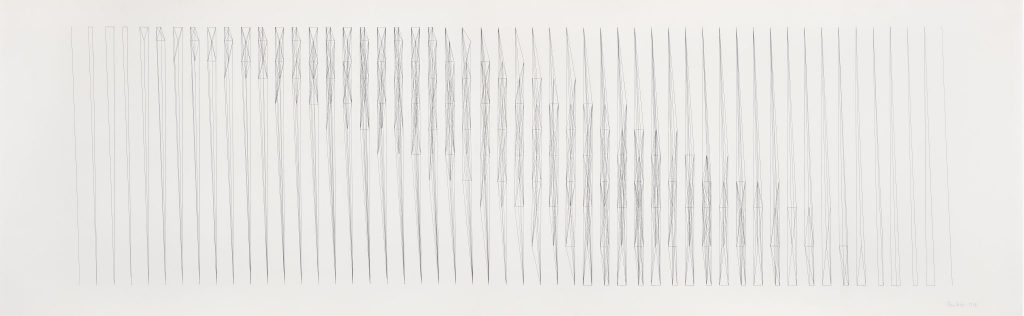
Mit der Werkreihe Menhir führte Elena Asins ihre Auseinandersetzung mit Raum, Ordnung und serieller Struktur auf architektonischer Ebene fort. Die Arbeit besteht aus einer Reihe von vierzig miteinander verbundenen Elementen, deren Anordnung nicht zufällig, sondern nach einem präzisen kombinatorischen System organisiert ist. Dieses folgt denselben Gesetzmäßigkeiten, die bereits ihrer Dolmen-Serie zugrunde lagen, verlagert die Struktur jedoch von einer überkreuzten hin zu einer linearen Lesbarkeit: Die Elemente entfalten sich nacheinander innerhalb eines räumlich-zeitlichen Kontinuums.
„Nachdem die Notwendigkeit der vorherigen Konstruktion erfüllt war, begann ich, einen Tempel für das Leben und die Stille zu erahnen und zu ersehnen — einen Ort der Meditation in einem zugleich architektonischen, bewohnbaren, klaren und erhabenen Raum. (…)Während die Besetzung des zweidimensionalen Raumes den Blick auf die Betrachtung der acht zweidimensionalen Menhire lenkt, die den neutralen Raum der umgebenden Wand einnehmen, zeigen diese in ihren jeweiligen Positionen die acht Möglichkeiten, die ein Menhir besitzt, wenn sein Winkel entsprechend der Bewegung der Zeiger einer Uhr gedreht wird.“
Teaching theoretical concepts, such as resilience or complexity theory, provides unique challenges especially in applied disciplines. Current trends such as global change will require natural resource disciplines, such as forestry and agriculture, to expand their scientific basis and possibly shift their dominant paradigms to adopt a broader view of the systems they manage as complex social-ecological systems. This likely will result in borrowing and adapting theories and concepts from other disciplines, such as complexity science. Students in natural resources will need more training in these paradigms and learn to incorporate concepts such as thresholds, uncertainty, and cross-scale interactions as they affect ecosystem dynamics into management or restoration prescriptions. Numerous courses and approaches exist that teach general complexity concepts, including management implications at the governance levels. However, we do not know of any courses where these concepts are specifically applied to practical management challenges. This course aims to overcome this shortcoming by providing field exercises that can are used to link theoretical concepts from complexity science to applied forest management issues regardless of management objectives.
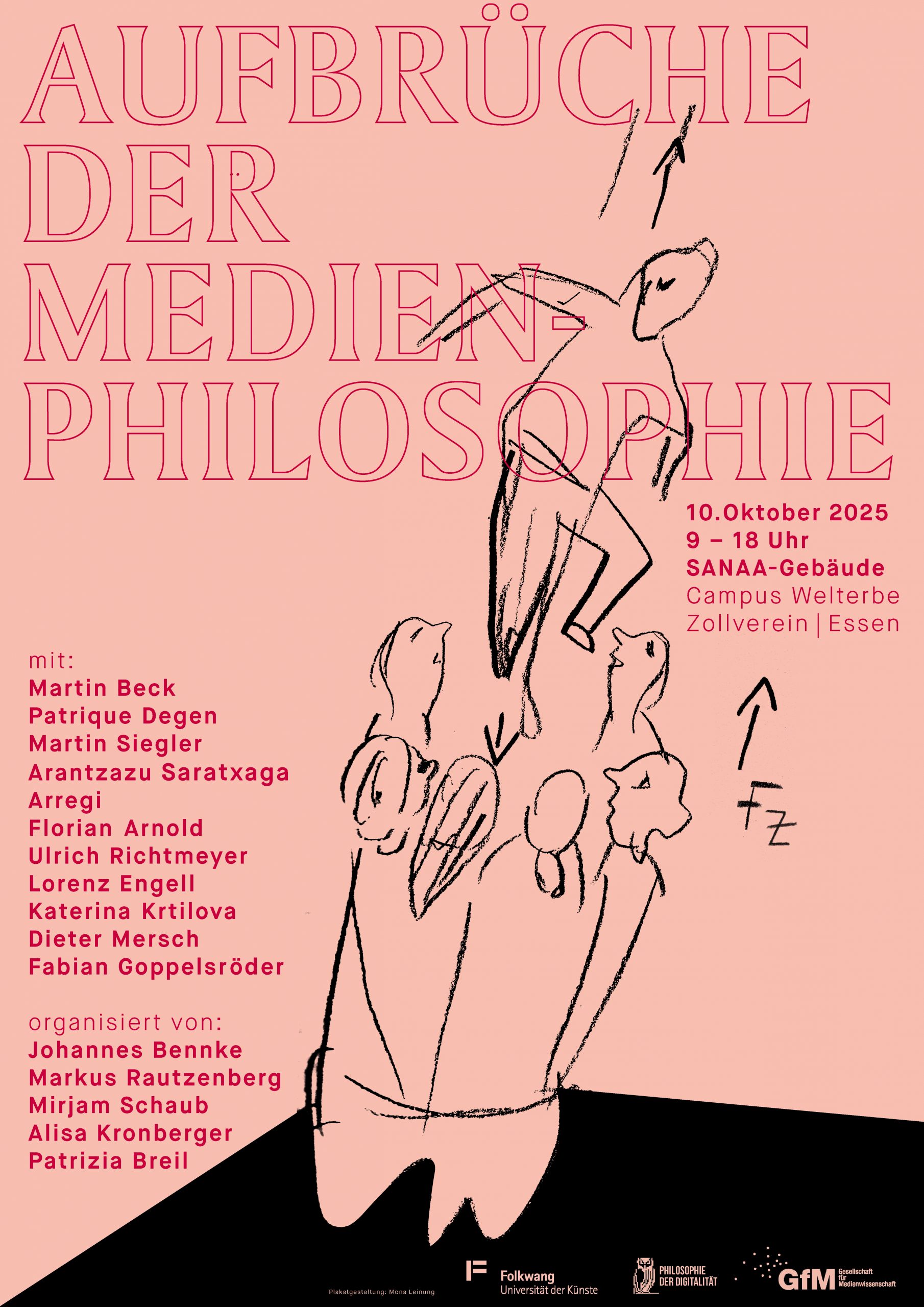
Es ist ein Vergnügen, an der Veranstaltung „Aufbrüche der Medienphilosophie” teilzunehmen, insbesondere an dem Vortrag „Der Kreislauf: Das Pharmakon der Asymmetrien”. Eine technikphilosophische Lesart des Verhältnisses von Zirkularität und Entropie” teilnehmen zu dürfen!
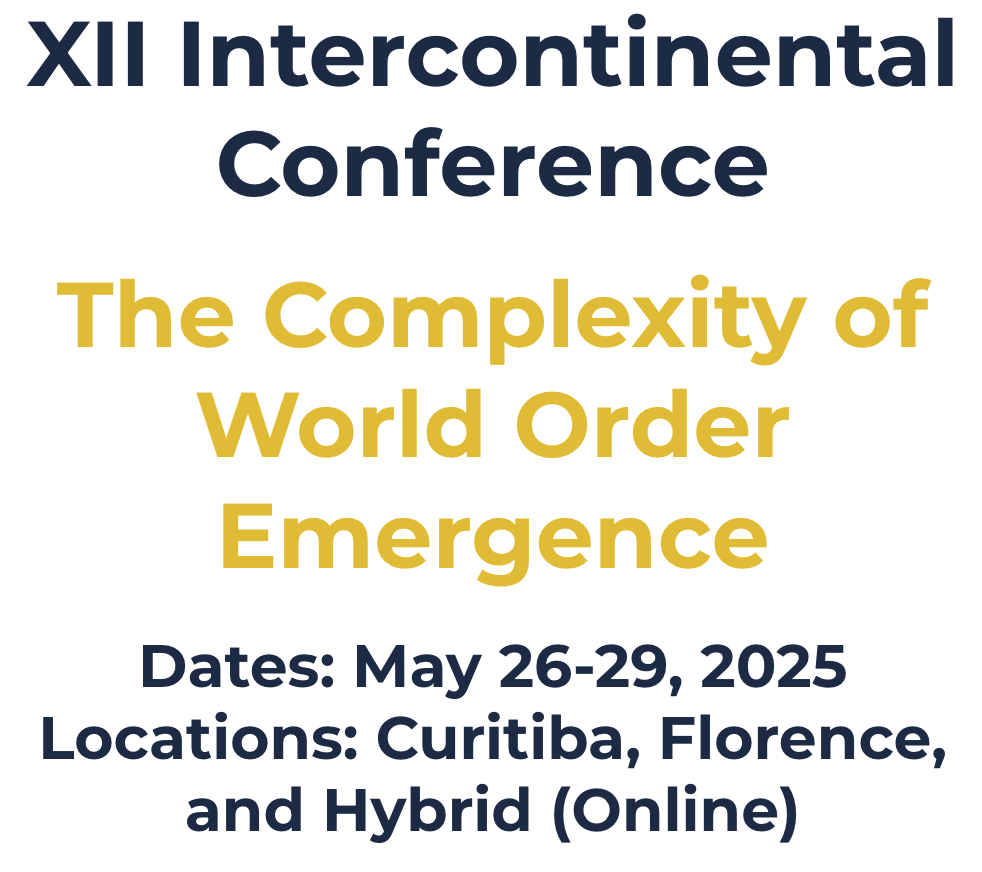
I am delighted to present my lecture, ‚Emergence through Environmental Embedding‘, at the XII Intercontinental Conference, ‚The Complexity of World Order Emergence‘, organised by the World Complexity Science Academy (WCSA).
Abstract
The aim of my presentation is to present the philosophical theories to understand the phenomenon of emergence, not as the matter itself, but as the (self-)organisation of the system. The organisation of the system arises from the relational correlation between system and environment, in such a way that the emergence can also be successful, under condition of embedding in the system. The ecological relational of embedding is the principle of generation of structures or emergence of patterns.
The ontological analysis of the concept of emergence shows that only the embedding of emergent properties in certain emergent levels or layers enables the permanent emergence of new structures. Conversely, the singular appearance of any new thing as an object, property, or structural element would only be an irrelevant variation of the given, which occurs constantly and everywhere anyway. The resulting ontological questions are, for example What is an emergent level? How do individual variations of the given gradually coalesce into emergent properties and objects? How can the relationship between different emergent levels be described?
The ontological approach to the study of emergence is thus holistic in nature, i.e. it sees the whole of a structural section of the world as the actual carrier of emergence. If we assume that emergence is a certain kind of event, i.e. a process, then emergence theory falls within the realm of general process philosophy. It follows that general process conditions, i.e. those that apply to any conceivable process, must also apply to emergent processes. Emergence as a structural phenomenon can thus be understood as a differentiation of antecedent process conditions.
It is a pleasure to present my lecture, „L’Endomilieu: The Interior is the Exterior of the System” at the 40th ASPLF Congress, “Cosmos: milieu, environment, univers,” at the Autonomous University of Madrid.
Abstract
The topic of this paper is an explanation of the inside/outside relation between the milieu and the system. I would like to place this discussion in the midst of two seemingly opposing views: On the one hand, the post-structuralist legacy of Foucault, along with the concept of environment of Deleuze and Guattari, who have assigned the latter towards an outside, and on the other hand, the concept of milieu of theories of operational closure (Heinz von Foerster, Niklas Luhmann, Gotthard Günther, etc), according to which the milieu is placed inside the system. The concept of environment represents an outside for both ecological studies and general systems theory. It is regarded as an outside that interacts with the system. The self-organization theories initiated a turn in the system/environment paradigm. Milieu or environment are no longer introduced into the order of observation as the outside, but only through their difference from the system or, in other words, via the opposition of system/environment. Through the dialectical method of re-entry, operative theories assume that there is no longer an outside, and if there is, it is introduced into the system as a blind spot. Thus, self-organization theories that have formulated openness to the outside and closure to the inside and provided formalization accodringly, contribute to the abolition of the concept of outside. The dissolution of an external objective reality is realized in exchange for an omnipotent subject that can see or observe everything. The inside of the system becomes the outside for self-organization theories as soon as it turns into a blind spot. The inside of a system, the black box that controls it and simultaneously classifies its input, forms the unpredictable outside of the observer. A dialogue between post-structuralist positions on the outside of thinking in combination with the approaches of the disappearance of the outside in the operative theories can be very fruitful for today’s conversations about an increasingly complex world and its means to observe its epistemology.
Am 1. April besuchte ich die Ausstellung „Programmierte Hoffnung“, „die erste umfassende und systematische Untersuchung der Bauabteilung an der HfG Ulm“ (Katalog 2025: 27). Basierend auf den reichen Beständen des Archivs dieser Hochschule für Gestaltung (HfG), von denen ein Teil mit dieser Ausstellung erstmals der Öffentlichkeit zugänglich gemacht wird, bietet sie einen fundierten Überblick über Geschichte, Lehrmethoden und zukunftsweisende Konzepte dieses bislang wenig erforschten Fachs. Dank gilt den Kuratoren der Ausstellung Dr. Chris Dähne (Goethe-Universität Frankfurt am Main), PD Dr.-Ing. Helge Svenshon (Technische Universität Darmstadt) und Dr. Martin Mäntele (Leiter des HfG-Archivs) für ihre großartige Arbeit.
# Geschichte
Otl Aicher und Inge Scholl sollen mit Max Bill (Mäntele 2025: 57) über ihre Idee gesprochen haben, eine Geschwister-Scholl-Hochschule zum Gedenken an die von den Nationalsozialisten ermordeten Geschwister Hans und Sophie Scholl zu gründen. Aicher, Scholl und Bill, der das Hauptgebäude entwarf, übernahmen die Gründung der Hochschule, die von der Mitte der 1950er-Jahre bis zu ihrem Ende 1968 eine der wichtigsten Hochschulen für Industriedesign der Nachkriegszeit war.
# Modellierung von Gesellschaft und Systemen: Curriculum
An der HfG Ulm entwickelte sich ein neues Architekturverständnis, das stark von neuen wissenschaftlichen Methoden und technischen Innovationen geprägt war. Es begann mit einem traditionellen Ansatz der Architektenausbildung bei Max Bill, der sich mit Konrad Wachsmann wandelte und mit Herbert Ohl den Schwerpunkt auf das industrialisierte Bauen legte.
Der Bezug zum einstigen Bauhaus in Dessau ist offensichtlich. Der Name der Hochschule für Gestaltung trägt die Zusatzbezeichnung des Staatlichen Bauhauses in Dessau, „Hochschule für Gestaltung“, nachdem Walter Gropius gefragt wurde, ob es in seinem Sinne sei, den vollen Namen, nämlich Bauhaus, zu übernehmen. Scholl, Aicher und Bill, so die zurückhaltende Antwort, machten diesen Zusatz geeignet. Ebenso bestand Aicher auf der Besonderheit der HfG Ulm, „kein zweites Bauhaus, keine Wiederholung“ (zitiert nach Mäntele 2025: 58) zu sein.
# Programmierte Hoffnung: Als die Information, die die Kommunikation zur Hoffnung beigetragen hat, programmiert.
Innovation hatte nicht den Anspruch, der Zukunft nach dem Muster moderner Funktionsoptimierung zu folgen. Innovation bedeutete für Ulm, Modelle, Strukturen und Konstruktionen für eine Welt der Zukunft zu entwerfen. Vielmehr lag der Schwerpunkt der Innovation auf der Notwendigkeit, Hoffnung durch und mit systemischem Denken, Kybernetik, visuellen Methoden und Informationsästhetik zu gestalten. Claude Schnaidt, ehemaliger Dozent im Erziehungsfakultät, prägte 1964 den Begriff „prefabricated hope“.
Hoffnung war kein ethischer Wert, wenn man sie als praktische Handlungskategorie betrachtet, sondern eine Utopie: „Hope as a driving force for societal change and progress“ (Katalog 2025: 25). Ernst Bloch besuchte die Schule 1964.
Blochs Philosophie der Hoffnung sollte sich als roter Faden durch die Strukturen und Konstruktionen einer noch zu schaffenden Gesellschaft ziehen. Die Philosophie der Hoffnung war eine Inspirationsquelle für die Gestaltung wissenschaftlicher Disziplinen, wie die „Futurologie“. Die zukunftsorientierte Gestaltungsdisziplin wurde zum Gegenstand von Forschung und Lehre an der Hochschule. In Anlehnung an Herbert Ohl schrieb er einmal:
„If one question reality today and sets aside social, economic, and technical occurrences, one will invariably find oneself compelled to design utopias. These (…) can nevertheless possess the character of insightful experiments and assume the function of role models“ (zit. nach Katalog 2005: 26).
# Kybernetik & Informationsästhetik: Wege zur Utopie
Die Kybernetik stand damals nicht nur im Dienst der operativen Forschung oder der Steuerungspolitik. Sie diente auch dem Entwurf von Modellen und Strukturen für eine Welt der Zukunft. Die HfG Ulm war ein Nischenlabor für utopisches Gestalten mithilfe von Kommunikationskreisläufen, Information und Technik. Der Philosoph und Wissenschaftstheoretiker Max Bense führte moderne Disziplinen wie Kybernetik und Informationsästhetik ein, die ein „technisches Bewusstsein“ fördern. Bense definierte Methodologie als eine Art, komplexe technische und ästhetische Phänomene zu ordnen. 1964 entwickelte der Physiker und Kommunikationswissenschaftler Abraham Moles Benses Theorien der Information und Ästhetik weiter. Helmar G. Frank, eine Schlüsselfigur der Kybernetik und Strukturtheorie, ergänzte sie um theoretische Disziplinen. Norbert Wiener hielt 1956 einen Vortrag über künstliche Grammatiken für Universalsprachen.
Eine harmonische Verbindung von Systemdenken, kybernetischen Ansätzen und analytischen Verfahren zielte auf die Gesellschaft der Zukunft ab. Dabei ging es weniger um Kontrolle als um eine Ästhetik der Hoffnung durch Kommunikation, um einen neuen logischen, technischen und analytischen Zugang zu generativen Gestaltungsprozessen, die dem Bauen der Zukunft eine Gestalt geben sollten.
We are delighted that there is an anthology on the topicality of cybernetics, which can only reflect its reconstruction for the present. The title Cybernetics for the 21st Century may indeed immediately raise the question: why cybernetics, and why now? (Hui 2024, 11). Cybernetics is no longer history; it has often been relegated by media studies to material on the news technologies of the second half of the 20th century. It is still presented as history, as material for an archaeology of the digital turn, in order at best to place communication at the forefront of a history of the emergence of AI, and at worst to equate digitality with an ideology of control. Cybernetics is categorised as a discipline of control of and through communication. Indeed, Norbert Wiener defined it in 1948 as the science of communication and control (1948). However, this is to be understood as control and regulation, whose formal term „circular causality“ contributed the title of the conference: „Circular Causal and Feedback Mechanisms in Biological and Social Systems“, which constituted cybernetics as a science.
The history of cybernetics is thus the application of feedback mechanisms through data processing and information in their respective contexts. As a science that emerged in the post-war period, it has been categorised as a rationalisation model of technical mobilisation, with government strategy focused on ensuring security and order for the civilian population (operational research) and the promise of perpetual peace through control. Examples of this, as explained in the second part of this review, are the application of cybernetics to the one-child policy in China (Dylan Levi King), the ambivalence towards the concept of control in Soviet cybernetics (Slava Gerovitch), and the opening up of the relationship between AI and political power, which was welcomed early in Poland (Michał Krzykawski).
Yet the cybernetics of the 21st century is not the cybernetics of the post-war period, nor is it cybernetics with a K, as Claus Pias believed, whose reception in the 1970s and 1980s led to an epistemological movement called constructivism, having an enormous impact on the soft sciences and triggering an epistemic turn in philosophy. Similarly, the cybernetics of the 21st century is not the cybernetics with a C that represented an emancipatory ideal of posthumanist ideas in the context of American subcultures. The cybernetics of the 21st century includes the historicity of cybernetics. It is not limited to a critical revision of its programme and application in different contexts. Nor is it limited to the question of the sincerity of the cybernetic programme in its application to organisational and management policy.
This work is about the present of cybernetics. The anthology Cybernetics for the 21st Century consists of 12 essays on the reconstruction of cybernetics. Its aim, to design a cybernetics for this century, has been achieved, as can be expected, because it shows the complexity of its conception and the diversity of its fields of application. This is precisely what this book is about. Even if it is almost unavoidable, especially in the practice of scientific research, to refer repeatedly to the origin from which cybernetics supposedly emerged – be this Norbert Wiener’s Cybernetics, Andrè-Marie Amperè’s use of the term “cybernetyka” in 1834, or the Macy conferences, a reconstruction aiming to show the diversity of applications of a technical model with different objectives in different geographies. The point is not to speak of cybernetics in the singular but, rather, following Yuk Hui’s welcome term “cosmotechnics”, to bring up diversity as the locus of its singular interpretations. This is an attempt to map cybernetics.
The first part of the anthology deals with the basic ideas of cybernetics. Philosophical and epistemological disputes with cybernetic approaches are discussed. But why is cybernetics relevant today? This question already reveals the timeliness of its discourse. The extent to which this model contributes to understanding and problematising contemporary reality is part of its reconstruction. The first part analyses cybernetics as a model of thought from various perspectives. Cybernetics could be described as an epistemological model. In his book Recursivity and Contingency (Hui 2019), Yuk Hui argues that cybernetics is a reflexive philosophy of technology, since the reflexive movement of this interactive process (self-reference) takes place through communication and control loops. This thesis can be well supported by the philosophies of consciousness if the tradition anchored in philosophy around the reflexivity of consciousness confirms the foundations of cybernetics as a philosophy. Hui goes so far as to suggest that the 19th century philosophies of reflexivity provided the epistemological building blocks of the cybernetic model.
Technical reflexivity, automation, cannot be understood without the emergence of the philosophy of consciousness. To this end, this volume presents the epistemological interpretation of cybernetics. The second part of the anthology, entitled „Territories“, demonstrates that cybernetics is an applied model of thought and cognition. There are as many cyberneticists as there are places of application. „Because cybernetics could be applied in the realisation of a socialist, a communist as well as an arch-liberal management“ (Hui 2024, 14). Part 2 is devoted to reconstructing the localised history of cybernetics in Poland, Chile, the Soviet Union, China, Japan, the USA and the UK.
Cybernetics as a philosophical project
The topicality of cybernetics is introduced by a clear and concise statement by Hui, actually based on his proposal for this volume: “Cybernetics has been a philosophical project since the beginning” (Hui 2024, 12). He proposes two paths leading to the statement that cybernetics is a philosophical project. The positive statement inherent in this is that there were cybernetic elements in philosophy before it became a communication technology as a programme. This new epistemology, which in fact brings cybernetics to fruition through communication channels, is not new; rather, it was already present in the history of philosophy. Yet this positive assertion is argued via negationis. Hui draws upon a negative statement as an introduction to a reflection on the philosophy of cybernetics. This goes back to Martin Heidegger’s statement in the so-called interview in Der Spiegel in 1966: „Only a God can save us“. This comment was made in relation to the dissolution of philosophy into individual sciences such as psychology, political science, etc., followed by the question: „And who will take the place of philosophy?“ His answer was: „Cybernetics“ (Heidegger 1976, 212). Hui comments on this:
He [Heidegger] announced that cybernetics marked the end of Western philosophy. This assertion is dramatic but significant for reflecting not only on the history and future of philosophy, but also on the future of cybernetics. (Hui 2024, 12)
Heidegger clearly equates the end of philosophy with cybernetics. However, such a vague statement, which presupposes an eschatological view of philosophy that is not explained in this article, raises too many questions. Speaking of an end brought about by the victors and losers is, in my opinion, a repetition of the myth of control, which in most cases testifies to a convenience of thinking, an end that the victors of technological domination will have to tolerate and from which thinking must say goodbye.
The statement about the end of philosophy reveals cybernetics to be a philosophical project
The end is the completion of a beginning. Hui thus derives an even more promising approach from the end of philosophy on the basis of cybernetics: cybernetics was a philosophical project from the very beginning.
For Heidegger, the triumph of cybernetics therefore equally means the end of philosophy. In view of such end of philosophy, Heidegger calls for a thinking to come; a thinking that is able to overcome the latest and last stage of Western philosophy: cybernetics. (Hui 2024, 12)
Of course, cybernetics has displaced philosophy, as Hui points out. Cybernetics as universal reflexive thinking has displaced philosophy from its traditional place (Hörl 2008, 163-198). Michael Hagner speaks of the fourth disease of man as a consequence of the first, cosmological repression, the second, psychoanalytical, the third, anthropological, and the fourth, spiritual repression (Hagner 2008, 38). Spiritual repression, which manifests itself in various forms, such as the „objectification of drives“ through a high degree of automation of institutions (Gehlen 2004, 74-78), the „reification and objectification of certain processes that constitute the essence of man“ (Hagner 2008, 57), or the replacement of the self-reflection of consciousness by information technology, heralded the dissolution of subjective thought. For Heidegger, reflection is indeed one of the fundamental characteristics of thinking, as he shows in his essay „On the Question of the Determination of the Matter of Thinking“ (Heidegger 1984). In cybernetics, which is essentially based on circuits, Heidegger sees a technical model of reflection that can to some extent replace the formal operation of thinking. Yet here cybernetics reflects the universalism of thought and announces its end because, as its historicity shows us, it initiated its fragmentation into several approaches to thinking.
Nevertheless, when approached as a philosophical project, cybernetics has opened up new ways of thinking. Gotthard Günther’s project is the end of reflection-logical idealism and the opening, even the redemption, of Aristotelian dual-valued logic to a polycontextual multivalence (Günther 1976), a liberating ontology that was warmly welcomed by the new cybernetic thinking. In terms of the philosophical-anthropological perspective of a new philosophy, Max Bense speaks of technical being, of man as a technical being (Bense 1969). He sees it not just as a further step in the history of technology but as a meta-technology, a philosophical matter in which the foundations, objects and connections of the positive sciences, the humanities and the natural sciences, are examined. Abraham Moles speaks of cybernetics as a philosophical-aesthetic project, the emphasis on objectivity (Moles 1971). Arnold Gehlen sees feedback as the essence of the human being (Gehlen 2007). Cybernetics wants nothing more than to transfer the characteristics of this essence to technology and thus complete it. Hui locates epistemology in reflexivity, which he calls “recursivity” in his book Recursivity and Contingency. This is the reflexivity that founded philosophy as a theory of knowledge and consciousness in the first place, namely the return to the self, from whose movement the light of the mind emerges.
This volume aims to show that cybernetics is not just a control technology, but also a philosophy, and that its topicality is due to the different epistemologies of cybernetics. An epistemological reconstruction reveals the philosophy underlying cybernetics, which has made it a universal science whose legitimacy today lies exclusively in AI and technical formalism. This volume aims to reclaim the philosophy.
The beginning of a philosophy that became cybernetic
This volume shows the philosophical background of cybernetics not only via negationis, for example, in that an end – or a completion in the sense of Heidegger – reveals the essence of a beginning. It is precisely the completion of philosophy by cybernetics that reveals the philosophical nature of cybernetics from the very start. In this sense, the volume provides the argument, beyond the negative paths, that cybernetics is based on a philosophical project. I will consider the two paths that the volume points out, which provide good reasons for a philosophical reconstruction of cybernetics: 1) the reflexive logic of the machine, i.e. automation, responds to the transfer of the self-reflexivity of consciousness to the machine; 2) cybernetics as a project in the philosophy of technology that aims to abolish the hitherto irreconcilable views of mechanism and vitalism. Cybernetics has thus programmatically introduced the system-philosophical claim of scientific universalism.
Reflexivityand automation
Nietzsche warns that every genealogy reconstructs a history. We can even rethink and reshape the history of Western philosophy in the light of a cybernetic perspective says Brunella Antomarini (Antomarini 2024, 23). Whether we locate the beginnings of cybernetics in Plato’s metaphysics or in Leibniz’s monistic philosophy (Hui 2024, 12) depends on which story we want to tell. According to Heidegger, Plato’s metaphysics anticipates the arrival of cybernetics. Norbert Wiener sees Leibniz’s mathematics – the differential equation – as a fundamental basis for what he understands by cybernetics. As is well known, the name “cybernetics” comes from the title of Wiener’s 1948 book Cybernetics or Control and Communication in the Animal and the Machine. This is the Greek translation of the title „On Governors“, which James Clerk Maxwell used in 1868 for an article on the mechanisms of temperature regulation. Wiener adopted the Greek word „κυβέρνησις“, which Plato used in the figurative sense of „ruler of a government“ to describe the principle of communication regulation.
We have Brunella Antomarini to thank for reconstructing cybernetics following Leibniz’s metaphysics. This is not an anachronism – of course, cybernetics was not yet possible in the 20th century – but a genealogical perspective, and it shows us another line of thought in Wiener’s cybernetics that is just as important as that of control: automation. It shows nicely how automation emerged from the Western philosophy of self-reflection, the formalisation of which we owe to Leibnizʼs metaphysics. In fact, Leibniz’s metaphysics and mathematics were fundamental contributions to Wiener’s concept of automation based on control and signal transmission: „Leibniz as the patron saint of cybernetics“ (Antomarini 2024, 23). According to Antomarini, the circular logic that cybernetics implies through the communication channels, i.e. self-regulation, self-reference, can be found in the idea of self-motion conceived by Leibniz. Self-motion is said to be driven by a force vive (Antomarini 2024, 32) based on the mechanical impact of bodies. The conservation of energy, which was physically and mathematically proven in the following century, was already secured by Leibniz in the three philosophical principles („theorem of sufficient reason“, „theorem of the identity of the indistinguishable“ and „presupposed harmony“). The self-sustaining movement follows the mechanical dream of the perpetuum mobile, the second form of which cybernetics seeks to realise with its fully automatic claims (Antomarini 2024, 35). The author points out the harbingers of cybernetics and the completion of metaphysics in Leibniz’s metaphysics, since Leibniz had already anticipated a life force that could be realised through operational differential equations.
The abolition of dualisms
The second argument in favour of a philosophical foundation for cybernetics is the abolition of the mind/matter dualism that has held together Western thought culture in every respect. Mind and matter should merge in communication circuits through information, which is neither energy nor matter, but a unit of measurement for probabilities. We have already pointed out regarding Antomarini’s contribution that Leibniz’s self-moving force was an expression of the collapse of the separation between the organic and the inorganic maintained by early modern philosophy. With the transfer of the concept of self-regulation (haemostasis) from physiology to information-based communication circuits, the bridge between the mechanistic view of the world and living systems was finally built. The first attempt to build a self-regulating machine was based on its interaction with an environment. The steam engine, an environmental machine in that it converted heat into power, held all the promise of a perpetual motion machine of the second kind. One example of the technical realisation of this promise is Carnot’s “ideal circle” but it is only with information-based control systems that the machine adapts by interacting with its environment, i.e. it stores information and learns. The machine-environment interaction occurs operationally in that the machine is embedded in an open environment – thermodynamically open – with which it is in constant exchange and to which the system adapts, changes and transforms, etc.
Rather, and above all, it is the science of organisms and their effect on the environment. This says nothing a priori about the inner nature of the organisms in question. They may be biological, mechanical or sociological. Cybernetics deliberately leaves open the question of whether the mechanism under study consists of ‚living cells‘, of a community of chemical reactions, of a group of individuals acting collectively, of interlocks or relays. (Moles 1959, 8)
Yuk Hui’s contribution does not focus on the technical-scientific revolution of a „transclassical machine“, as Max Bense calls it, but instead sees it as exemplary in the abolition of dualisms, which, as already indicated, underlie Western metaphysics. In his contribution „Environment and Machine“, he emphasises the dissolution of dualism through recursive information machines.
Cybernetics endeavours to eliminate dualism; it wants to create a connection between different orders or magnitude to what Hans Jonas describes in Phenomenon of Life, regarding cybernetics as ‘an overcoming to dualism which classical materials had left in possession by default’. (Hui 2024, 45)
In fact, the end of duality and opposites had raised hopes for all theories and epistemologies that build bridges to seek connections where there were divisions. Reconciling man as a natural and spiritual being with technology was a challenge of the anthropological philosophy of the time, a challenge that Arnold Gehlen took up. However, an abolition of dualisms requires a reconstruction of the meaning of “environment”. In his article „Environment and Machine“, he describes the unnatural interpretation of environment. Based on the idea of „homeostasis“, which cybernetics partly borrows from physiology, environment means what surrounds the machine, with which it exchanges both energy and information. Machines imitate living systems in that they transform communication systems that must adapt to the environment in order to survive, and that adapt through self-regulation. What is actually being equated is not communication systems with living systems, as the title of Wiener’s work „Cybernetics or Control and Communication in the Animal and the Machine“ suggests, but the environments. The environment of the machine is similar to the environment of the organism in that it is what surrounds the system and exchanges information. “In this sense, a cybernetic machine is no longer merely mechanistic, but rather assimilates certain behaviours of organisms” (Hui 2024, 46). The machines interact with the environment, which allows information to be generated for adaptation – learning. In this sense, a transclassical machine is closer to the behaviour of an organism than that of a machine. Both are in a thermodynamically open relationship with the environment. The environment affects the system, which responds by affecting the environment. In this feedback game, the system should regulate itself and thus adapt optimally to its environment.
The volume presents another example of the denaturalisation of the concept of the environment on the basis of cybernetics. Katherine Hayles and Dorion Sagan consider the metaphorisation of the Earth as a cybernetic entity. Lovelock and Margulis‘ Gaia theory promised a holistic view of the Earth as a symbiotic and self-regulating organic being. Margulis‘ preliminary work on endosymbiont theories of prokaryotic cells, from which he derived a new taxonomy or evolutionary tree (Margulis 1998), led to a new taxonomy and order in the morphogenesis of living organisms through biochemical processes that had less to do with the claims of a holistic and totalitarian system, and rather revealed relationships and connections where classical taxonomy maintained divisions. Gaia theory, as Bruce Clarke shows well in Neocybernetics (Clarke 2020) after Luhmann, can only be observed as a blind spot.
The historicity of cybernetics proves it to be an applied philosophy
The abolition of dualisms between social, biological and technical systems through communication is followed by the dream of a total operative technology that can control communication systems in general. Peter Galison’s 1992 thesis of a Big Science tells of central control technologies in connection with the establishment of totalitarian models of government, although the illusion of absolute and total, holistic and systemic control over all subsystems goes back to the scientific mobilisation of the Second World War (Galison 1992). However, the utopia of totalitarian power in the post-war period (Bowker 1999, 107-127) turns out to be a dystopia. Mathieu Tricolt’s contribution „Ontology and the Politics of Information in Early Cybernetics“ sheds light on the darker side of cybernetics. Cybernetics as a universal science served as an ideology of mobilisation. The universal claim of a science was the basis for the very skilful technique of the art of government, which was capable of creating a total and global governmentality.
The second part of the volume shows how a philosophy that invoked the overcoming of divisions and relational thinking nevertheless sought to realise totalitarian dreams of control. However, as Pickering’s contribution makes clear, the historical discourse of cybernetics has focused too much on the global technology of government and completely ignored the diversity, locality, ambiguity of control and governance, etc. (Pickering 2024, 112f.). The second part of the volume, „Territories“, which presents the real-political history of cybernetics in a variety of ways, bears witness to this. Six documented cases of application show that cybernetics is not a universal science. Cybernetics may be a map to which no territory can be assigned, but it creates the applied practice by marking places on it. There is as many cybernetics as there are applications of localisation, and as many interpretations of the term’s control, freedom, etc. as there are contexts of application. Consequently, there can be no question of global and total knowledge.
Control and freedom
Andrew Pickering is right when he says that critics have become one-sidedly fixated on the word “control” in cybernetics (Pickering 2024, 112). He implies that there are multiple interpretations of a control machine.
Cybernetics was invented in the 1940s, around the time of World War II. In 1948 Norbert Wiener defined it as the science of communication and control, describing is as a synthesis of ideas about information, digital computing and feedback. These fields have since developed in very different ways in different times and places (Pickering 2024, 111)
The application of cybernetic systems to different political, cultural and social contexts leads to different cybernetic designs. This leads to a vast ambiguity of basic concepts. For example, the term „control“ takes on its meaning in the context in which it is used. The same goes for the other side of the coin: freedom.
Let’s take the operational meaning of control that Pickering’s essay addresses. Ashby understands control as the strategy of reducing an excess of complexity. It is not about eliminating uncertainties that disrupt the system, but about reducing an excess of complexity. A self-regulating system must maintain a certain level of complexity, but an excess can destroy the system. In his essay „On Self-organising Systems and their Environments“ (1985), Heinz von Foerster poses the question: „How much perturbation can a system tolerate?“ Operationally, the relationship between control and complexity is at the heart of regulation, which promises stability and order. According to Jakob Tanner, abstract „computational models“ were responsible for coping with increasing complexity during the Cold War, but the homeostatic model was inadequate for an excess of complexity. Control is a matter of stability. How does the system maintain order? In the UK, control means conversation:
As I have said, the best we can do with such systems is to get along with them, hopefully drawing them into our activities in a non-hierarchical process which another cyberneticist, Gordon Past, suggestively called ‚conversation‘. (Pickering 2024, 113)
The stability achieved through control in favour of the community meant freedom for the Soviet Union. In her contribution, Slava Gerovitch beautifully demonstrates the ambivalence of freedom depending on where the cybernetic model of control is applied. At the same time, North American ideology equates freedom with choice. The ideology of freedom is thus embedded in control. Jérôme Bruner’s cognitive psychology places freedom of choice at the centre of a model of intelligent activity in which choice is the basis of the right choice.
Brunerʼs work showcased the ‘cognitive revolution’ in psychology, closely associated with the work of the American AI pioneers Herbert Simon and Allen Newell, who placed choice at the heart of their ‘heuristic research’ model of intellectual activity. (Gerovitch 2024, 131)
The Soviet psychologist Andrei Brushlinskii, on the other hand, does not see free choice as a prerequisite for free decision.
Extending the control strategy to civil society: policy and control
The history of the application of cybernetics is varied. It was originally conceived as a rational model of warfare. It was applied in the post-war period with the aim of modernising war strategy in the governmental system, provided that the complexity of an organisation (government) was managed. In the Cold War era, it was concluded that the scientific-technological and epistemological-cultural conditions of the Second World War had changed. Some works argue that Big Science, i.e. universal science according to Galison, emerged from the scientific mobilisation of the world war (Hacking 1986, 237-260; Heims 1980; Falison/Bruce 1992; Galison 1997). As early as 1947, Crowther and Whiddington (1993, 595-642) drew up a knowledge balance sheet according to which leadership and events did not depend on the intuitions of the “leader”. Operational research (OR) was the new war strategy of the post-war period. The development of OR and cybernetics during the Cold War was rapid and unequivocal: OR meant planning not for the stability of the respective blocs, but for ensuring economic growth in the context of a bipolar bloc constellation between a capitalist market economy and a socialist planned economy. „Both American and Soviet scientists believed in the existence of a general, universal, ahistorical mechanism of human thought“ (Gerovitch 2024, 129).
As Dylan Levi King’s A Brief History of Chinese Cybernetics and Slava Gerovitch’s „Cybernetics Across Cultures“ show in detail, cybernetics became a model for the management of social systems in an increasingly complex governmentality, i.e. large populations whose behaviour had to be brought under control. The rational choice that Gerovitch speaks of is a consequence of the new rationality in post-war military strategy. Cybernetics emerged as an applied science for warfare. It attracted civilian scientists, and operational research remained in practice a strategy and method for problem-solving and decision-making. Michał Krzykawski explains how the model is used to manage organisations and social systems for civil purposes, in particular the planning strategy used to model macroeconomic processes.
Integration of cybernetics to define the economic model of distribution and plan: The relevance of Langeʼs approach to cybernetics consists in his demonstration that economic models based on cybernetic thinking can be effectively used for analyzing the dynamics of the economic processes. (Krzykawski 2024, 159f.)
The articles by Michał Krzykawski and Daisuke Harashima show how the new information processing techniques and the resulting control behaviour have been implemented in various fields of application.
The failure of cybernetics is partly justified
If a new volume is devoted to the reconstruction of cybernetics, it is because, in addition to the end of thinking, the end of cybernetics is also being proclaimed. Wolfgang Coy gave two reasons for this: „the breadth of its claims“ and „the narrowness of its method“ (Coy 2004, 257). The breadth of its claims refers to its claim to be a universal science. We have already emphasised that from its inception cybernetics has been hailed as a science with universal aspirations. The disappointment with cybernetics is justified, but only in part, because despite the development of a new logic for the rationalisation of war strategy and its implementation in operational research, cybernetics in particular has given rise to a new way of thinking and aesthetic expression. Warren McCulloch formulated the central questions of a 20th century teleology: „What characteristics of a machine are responsible for its telos, its purpose, its goal? And what characteristics of a machine define its purpose, goal, or telos?“ (von Foerster 1993, 122). A new teleology was born: circular teleology or the teleology of self-reference, a new causality that leads the epistemic relationship between subject/object to a total de-trivialisation. The complaint of anthropological philosophies about the objectification of thinking, which represents the last technical step in the history of mankind (Gehlen 2007), was followed by a de-trivialisation of the relationship between man and machine.
Nam June Paik’s television montages such as „Internet Dream“ are an expression of an early cybernetic aesthetic. Max Bense speaks of a technical being that leads aesthetics to futuristic positions. In his information-aesthetic programme, Abraham Moles shows how cybernetics ushered in a new epoch centred on computer simulation. An age of modelling and simulation could present the artist as a creator of new worldviews. For the humanities and aesthetics, especially architecture and design, cybernetics was undoubtedly an avant-garde. The essay by David Maulén de los Reyes demonstrates that the cyberneticisation of art in Latin America has led to a revolutionary movement in which constructivist models have brought about modernisation. However, this movement would not have been possible without the institutional cooperation between European and Latin American partners, which originated in the state art academies. As Maulén shows, the reconciliation of art with a technology that was not instrumental, but coupling and operative, produced an avant-garde in Europe. The Chinese cyberneticist Qian Xuesen „proposed a complete reorganisation of human thought that managed to integrate extrasensory perception, an alternative scientific method and a cybernetic theory of everything“ (Maulén 2024, 190).
Cybernetics as a closed model
One wonders why cybernetics failed as an avant-garde and liberating model. Why has this model, which transcended the old divisions that underpinned rationalist metaphysics, which taught relationality and environmentalism, become a model that restricts freedoms? Katherine Hayle argues in her contribution that the failure is due to the closed nature of the organisation. We already know that closure is a formal expression, the logic of circularity, according to which a system can set limits on itself that are in fact binding rather than definitive. The operation, i.e. the organisation, is closed insofar as it directs the system towards its own laws: auto-nomos. The closed nature of organisation and operation ensures the autonomy of the system. I believe, however, that while unity demonstrates autonomy, it can neither define an order nor promise its maintenance. On the contrary, closure is the core of the system’s constant differentiation and diversification. The rhizomatic hydra is the model of an operative closure that abolishes bivalent logic in favour of further differentiation in an open environment.
Conclusion: an eschatological view of the history of cybernetics
In the theological tradition, talk of the end of time („eschaton“) is called eschatology. As much as this term has triggered a discussion in Western philosophy of history, in which the end has been understood as a suspension, as completion, and as the discursive prelude to a revolutionary turning point in history (Taubes 1947, 106-117), the end and its discourse are beyond an apocalyptic vision. The end of thinking through cybernetics in its eschatological view shows the other side of completion: every end is followed by a new beginning. The end of universal knowledge, which triggered dualism, leaves room for reflexive, recursive, paradoxical, multivalent logical thinking. Its proponents, such as Ranulph Glanville and Gotthard Günther, have argued in favour of polycontextual multivalence, etc.
Redemption: the control of control
And so the end of thinking promises redemption (Erlösung) from trivial thinking. Second-order cybernetics could be salvation from control: as long as control can be controlled, if the observation of observation, the thinking of thinking, the way out to a critical statement, is guaranteed. In any case, in first-order cybernetics – because there is no first-order cybernetics – control, in its two forms of regulation and control, is assigned to communication. Control is through communication. Anyone who has studied communication theory knows that communication does not just mean mediation (Luhmann 1987, 193). Communication, as first formulated in Shannon and Weaver’s mathematical model of communication, is selection, choice, coding, decoding and transmission. According to Michel Serres, transmission is a transduction, i.e. the translation of one coded signal into another. What is more, the entire selection process is conditioned by the contingency of the outside, the unpredictable environment. In this sense, control means selection. This produces an ordered structure that creates a stable order through repetition, i.e. redundancy. Ordo ab Chao (Mersch 2013) can be seen as a form of control of the new power technology that brings order to the “outside” and creates stability where contingency prevails. Through communication Ordo ab Chao can also mean creating an order whose stability depends directly on non-linear processes. Communication means creating order, i.e. creating the world. In this respect, control through communication is never absolute. Second-order cybernetics, which benefits from operational closure and even constructs an entire epistemology, does not assert closure as an exclusively total form; rather, this form is always in relation to other observers who observe it and are observed at the same time. Operational closure is the basis of a control of control, a choice of choice, namely the decision, the choice of freedom, that the control can be observed. Observation as a formal expression is to be understood as any operation, including criticism. Observing control therefore means that control, in any form of order-making, is open to observation, i.e. to criticism (Saratxaga Arregi 2023).
Third-order cybernetics
Therefore, I do not believe that third-order cybernetics is necessary. As Dirk Baecker said in an interview (Baecker und Unterluggauer Ö1 16 May 20/22), the third order is contained in the second order, if we understand it as the operation of repetition and recursion of difference. However, there is already a third-order cybernetics, which is attributed to Russian cybernetics – Vladimir Lepskiy – and which focuses on the management and organisation of social agents. This is because third-order cybernetics cannot be ascribed to omniscient observers such as Google, Facebook and Amazon (Triclot 2024, 67), which are always to be observed and criticised.
Bibliography
Arendt, Hannah. Vom Leben des Geistes: Das Denken, das Wollen. Pipper,1998.
Bense, Max. Einführung in die informationstheoretische Ästhetik. Grundlegung und Anwendung in der Texttheorie. Rowohlt, 1969.
Blumenberg, Hans. Geistesgeschichte der Technik. Suhrkamp, 2009.
Bowker, Geoffrey, “How to be Universal: Some cybernetics Strategies 1943-70”, Social Studies of Science 23 (1999): 107-127.
Clarke, Bruce. Gaian Systems: Lynn Margulis, Neocybernetics, and the End oft he Anthropocene. Minesota Press, 2020
Coy, Wolfgang, “Zum Streit der Fakultäten: Kybernetik und Informaiton als wissenschaftliche Disziplinen.” In Cybernetics – Kybernetik II, edited by Pias, Claus. Diaphanes, 2004.
Foerster von, Heinz. Kybern-Ethik. Merve, 1993.
Foerster von, Heinz. “Über selbstorganisierende Systeme und ihre Umwelten”. In Sicht und Einsicht. Versuche zu einer operativen Erkenntnistheorie. Carl Auer Verlag, 2006.
Gehlen, Arnold. Urmensch und Spätkultur. Klostermann, 2004.
Gehlen, Arnold. Die Seele im technischen Zeitalter. Klostermann, 2007.
Günther. Gotthard (1976). Beiträge zur Grundlegung einer operationsfähigen Dialektik. Meiner, 1976.
Hui, Yuk (ed). Cybernetics fort he 21st Century. Vol.1: Epistemological Reconstruction. Hanart Press, 2024.
Hui, Yuk. Recursivity and Contingency, Rowman & Littlefield, 2019.
Heidegger, Martin & Rudolf Augstein, „Nur Gott kann uns retten“, Spiegel, n.23, 31st May1976.
Heidegger, Martin. Zur Sache nach der Bestimmung der Sache des Denkens. Eker-Verlag, 1984.
Hacking, Ian. “Weapons Research and the Form of Scientific Knowledege”, Canadian Journal of Philosophy, Supplement 12 (1986): 237-260.
Hagner, Michael. “Vom Aufstieg und Fall der Kybernetik als Universalwissenschaft”. In Die Transformationen des Humanen, editet by Hörl, Erich & Hagner, Michael. Suhrkamp, 2008.
Heims, Steve. John von Neuman and Norbert Wiener. From Mathematics to the Technologies of Life and Death, M.I.T. Press, 1980.
Hörl, Erich. “Das kybernetische Bild des Denkens”. In Die Transformationen des Humanen, editet by Hörl, Erich & Hagner, Michael. Suhrkamp, 2008.
Margulis, Lynn. Five Kingdoms, an Illustrated Guide to the Phyla of Life on Earth. Freeman, 1998.
Mersch, Dieter. Ordo ab chao. Diaphanes, 2013.
Moles Abraham, A. “Die Kybernetik, eine Revolution in der Stille”. In Epoche Atom und Automation. Enzyklopädie des technischen Zeitalters, Genf Band VII, 1959.
Moles, Abraham, A. Informationstheorie und ästhetische Wahrnehmung, DuMont Schauberg, 1971.
Galison, Peter, Hevly, Bruce. Big Science. The Growth of Large Scale Research. Stanford University Press, 1929.
Galison, Peter. Image and Logic. A Material Cultural of Microphysic. University Chicago Press, 1997.
Luhmann, Niklas. Soziale Systeme. Grundriss einer allgemeinen Theorie. Suhrkamp, 1987.
Saratxaga Arregi, Arantzazu (2023): “Wenn die Kontrolle hinterherkommt. Ein Essay zur Kybernetik”, Medienimpulse, 60, no.4 (2023)
Schelsky, Helmuth. Der Mensch in der wissenschaftlichen Zivilisation. Springer, 1961.
Galison, Peter. Big Science. The Growth of Large Scale Research. University Press,1992.
Radio interview:
Cybernetics 3rd order. On the renaissance of a discipline, by Mariann Unterluggauer, 16-May 2022, 19:05, Ö1 https://oe1.orf.at/programm/20220516/678842/Kybernetik-3-Ordnung